

18+ | Affiliate link | Terms apply | Please gamble responsibly.
Last Updated on September 28, 2026 by Maurya
Online slots have changed dramatically over the years. What was once a relatively simple game built around three reels and a handful of symbols has developed into a huge category featuring elaborate themes, animated bonus rounds, progressive jackpots, expanding reels, multipliers, free spins, and countless other features.
That variety can make finding the best online slot more difficult than it sounds.
A colourful design or an impressive jackpot might attract your attention, but neither tells you everything you need to know about how a slot actually works. Two games that look almost identical can have very different return-to-player percentages, volatility levels, betting ranges, bonus mechanics, and overall playing experiences.
The important point is that there is no single online slot that is objectively “best” for everyone. The right choice depends on your preferences, budget, tolerance for variance, and the type of gameplay you enjoy.
It is also important to remember that slots are games of chance. There is no strategy that can guarantee a profit, and selecting a game with certain characteristics does not remove the mathematical advantage built into gambling products.
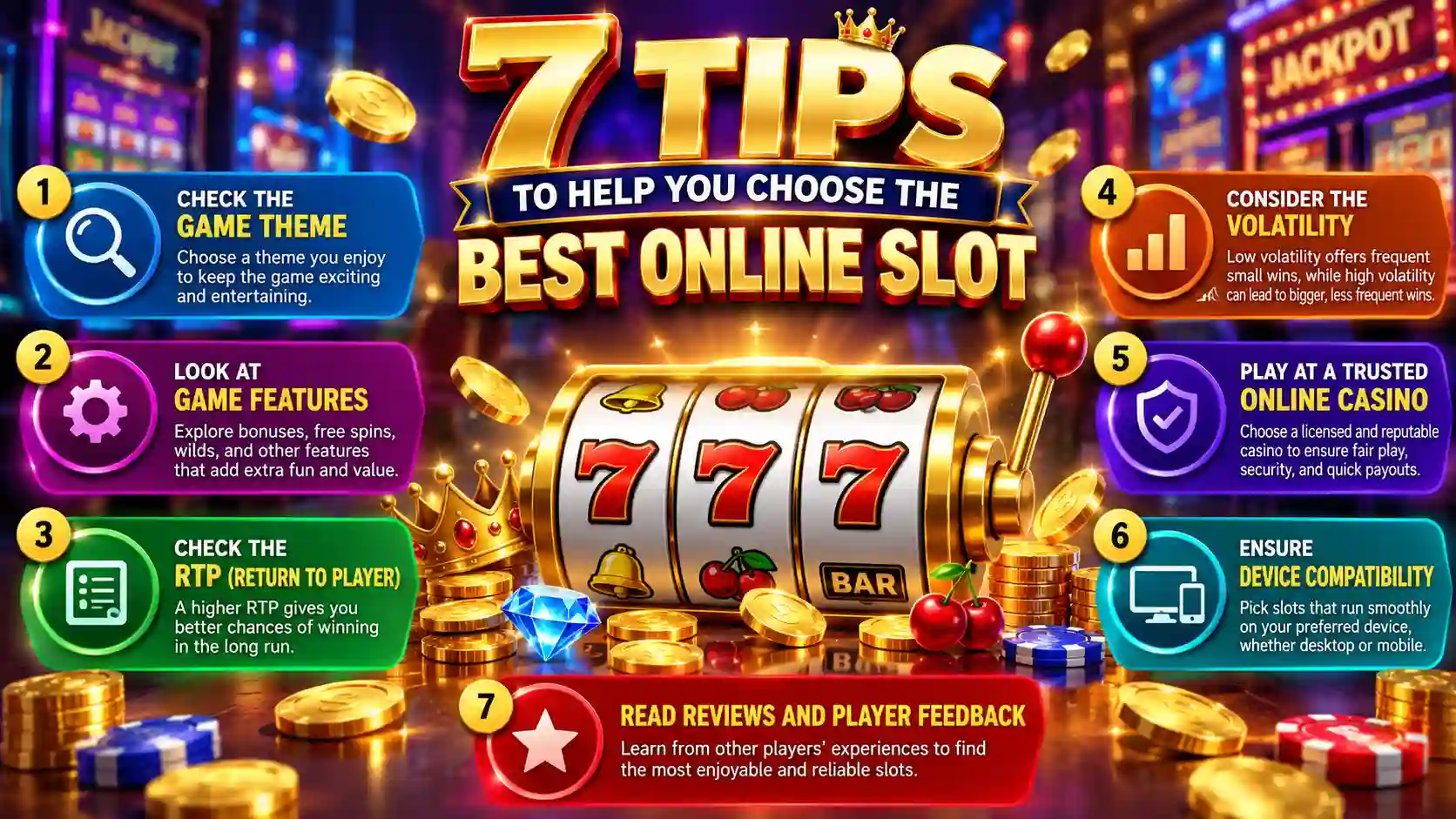
With that in mind, here are seven practical factors worth considering when comparing online slot games.
Start With Licensing, Regulation, and Game Transparency
Before comparing graphics, jackpots, or bonus features, look at where the slot is being offered.
A reputable online casino should operate under an appropriate gambling licence for the jurisdiction in which you are playing. Regulations vary between countries, so players should check the rules and approved operators of their own local gambling authority.
Why does this matter?
Regulated operators generally have to follow standards covering matters such as game fairness, customer funds, player information, responsible-gambling protections, complaints, and technical testing.
For example, the UK Gambling Commission requires regulated remote games to provide players with information about the rules and their likelihood of winning, which may be communicated using details such as RTP, house edge, or the probability of winning events.
Randomness is another important consideration.
Regulated gambling environments commonly require games using random number generators to meet technical standards. UK Gambling Commission guidance, for instance, states that random-number-generator outputs must be acceptably random and unpredictable.
In practical terms, you should be able to open a slot’s information or help section and understand fundamental details such as how winning combinations are created, how much different symbols pay, how bonus features operate, and what RTP applies.
Be cautious about a game or website when basic information is difficult to find.
The best online slot experience starts with transparency rather than flashy marketing.
Understand the Slot’s RTP Before Playing
One of the most useful numbers to understand when comparing online slots is RTP, or Return to Player.
RTP represents the theoretical percentage of money wagered on a game that is expected to be returned to players as prizes over a very large number of plays.
Suppose a slot has a theoretical RTP of 96%. That does not mean you should expect to receive £96 back after wagering £100 during an individual session.
RTP is a long-term mathematical measurement rather than a prediction of what will happen to one player.
The UK Gambling Commission specifically explains that RTP is achieved over a significant number of games and should not be interpreted as the amount an individual player will receive back during a particular session.
That distinction is extremely important.
You might play a high-RTP slot and lose your entire session budget. Another player could play exactly the same game and win considerably more than they wagered. Short-term outcomes remain unpredictable.
So why check RTP at all?
Because it helps you understand the underlying mathematics of the game and compare similar options more intelligently.
If two slots offer comparable themes and gameplay but have noticeably different theoretical RTP percentages, knowing those figures gives you another piece of objective information on which to base your choice.
Check the game’s official information screen rather than relying solely on third-party descriptions. Some slot titles may be available in different mathematical configurations, meaning the RTP can sometimes vary depending on the version selected by an operator.
Remember the key rule: RTP describes long-term theoretical performance, not your next spin.
Choose a Volatility Level That Matches Your Playing Style
RTP receives plenty of attention, but it is only one part of a slot’s mathematical profile.
Volatility, sometimes called variance, describes how a game’s payouts tend to be distributed.
Understanding this concept can make a significant difference to your experience.
A lower-volatility slot generally tends to produce smaller wins more frequently. A high-volatility slot may produce winning combinations less frequently but has the potential for larger payouts when certain combinations or features occur.
Neither type is automatically better.
Imagine two players.
One prefers longer entertainment sessions and enjoys seeing regular smaller payouts. That person may prefer a lower- or medium-volatility game.
Another player is comfortable with longer periods without meaningful wins and prefers games built around less frequent but potentially larger payouts. High-volatility slots may better suit that preference.
The key is recognizing that volatility affects the rhythm of the game.
It also helps explain why RTP alone should never be used to predict the feel of a slot. Two games could have similar RTP figures while producing completely different experiences because their volatility structures are different.
Regulatory guidance on RTP monitoring also recognizes volatility as an important factor because actual game results can fluctuate around theoretical RTP over shorter periods.
Before playing, check whether the developer identifies the game as low, medium, or high volatility. If that information is unavailable, the paytable and feature descriptions may still provide some clues, although they should not be treated as a substitute for official information.
Choose volatility according to your preferences and predetermined budget—not according to the assumption that one volatility level is an easier route to profit.
There is no guaranteed winning option.
Check the Betting Range, Paytable, and Game Rules
A slot can have impressive graphics and exciting features yet still be a poor match if its betting structure does not suit your budget.
Before starting, examine the minimum and maximum stake available.
This matters because sustainable gambling begins with deciding how much money you are prepared to spend rather than choosing your spending level after you have already started playing.
The paytable is equally important.
Modern slot mechanics vary considerably. Traditional games might use fixed paylines, while newer titles can include hundreds or thousands of ways to win, cluster-pays systems, cascading symbols, expanding grids, or other mechanics.
Do not assume every game works the same way.
Open the information panel and establish exactly what constitutes a winning combination. Check whether the amount wagered influences jackpot eligibility, feature access, or potential payouts.
Pay particular attention to optional features requiring an additional stake. A bonus-buy mechanism, where permitted, can cost significantly more than an ordinary spin. Understand the cost before using it.
Local regulations can also affect stake sizes.
In Great Britain, for example, statutory online-slot stake limits are currently £5 per game cycle for adults aged 25 and over and £2 for adults aged 18 to 24. The £5 limit took effect on 9 April 2025, while the £2 under-25 limit took effect on 21 May 2025.
Rules differ internationally, so always check the requirements applying where you live.
The broader principle is straightforward: a suitable slot should let you play at a stake that fits comfortably within the spending limit you established beforehand.
Increasing your stake in an attempt to recover previous losses is not a sound strategy.
Evaluate Bonus Features Instead of Being Distracted by Them
Bonus features have become one of the biggest selling points of modern online slots.
Free spins, wild symbols, multipliers, respins, expanding reels, cascading wins, mystery symbols, pick-and-win rounds, and progressive jackpots can all make gameplay more varied.
But more features do not automatically make a slot better.
Ask what those features actually do.
A free-spins round may look impressive, for example, but you should understand how it is triggered and what changes during the feature. Does it introduce multipliers? Additional wilds? More symbols? Different reel configurations?
The same applies to jackpots.
Progressive jackpot slots can advertise extremely large top prizes because a jackpot pool can increase as qualifying bets are made. However, the size of the headline prize should not be confused with the probability of actually winning it.
Read the rules.
You should also distinguish genuine winnings from visual or audio effects designed to make an outcome feel more significant.
Game design is an area regulators have examined closely. In Great Britain, changes introduced for online slots prohibited features including autoplay and certain functionality designed to accelerate play or create an illusion of control. Operators must also avoid celebratory sounds or imagery for outcomes where the return is equal to or less than the stake.
This highlights a useful principle when choosing an online slot: focus on how the mechanics work rather than how exciting they look.
Animations are entertainment. Mathematics determines the underlying game.
Consider the Developer, User Experience, and Mobile Performance
A slot should also be enjoyable to use.
Established software developers generally provide clear game information, polished interfaces, reliable mobile optimisation, and consistent technical performance. That does not mean every title from a well-known developer will suit you, but identifying the provider can give you useful information about the game’s design and documentation.
Pay attention to usability.
Can you easily find the paytable?
Are the stake controls obvious?
Can you understand your current bet without searching through menus?
Does the interface clearly display wins and account changes?
Can you see the game comfortably on your phone without accidentally pressing controls?
These details matter more than many players initially expect.
Mobile performance is especially important because a large proportion of online casino play now occurs through smartphones and tablets. A slot designed primarily around desktop screens may not offer the same experience on a smaller display.
Where legal and available, a free-play or demonstration version can help you understand the interface and mechanics before deciding whether to use real money. Remember, however, that a demo session does not predict future results in real-money play.
Use demo mode primarily to answer practical questions: Do you enjoy the theme? Do you understand the rules? Are the animations distracting? Can you follow the bonus features? Is the game too fast or too complicated for your preferences?
Good design should make the game easier to understand—not obscure what is happening.
Make Responsible-Gambling Features Part of Your Decision
This may be the most important tip of all.
The best online slot for you is not simply the one with your favourite theme or a particular RTP. It should also be played in an environment where you can keep clear control over your time and money.
Set your budget before playing.
That budget should come from disposable entertainment money rather than funds required for rent, food, bills, debt repayments, savings goals, or other necessities.
Setting a time limit can be just as valuable as setting a financial limit.
GambleAware recommends deciding on spending and time limits in advance and warns against chasing losses. Trying to recover previously lost money can result in even greater losses.
Where available, consider tools such as deposit limits, spending limits, session reminders, reality checks, time-outs, and self-exclusion.
These tools should not be viewed as something needed only after gambling becomes difficult. They can be useful preventive controls.
It is also worth paying attention to how you feel while playing.
If you find yourself increasing stakes because you are frustrated, extending a session because you feel you are “due” a win, or gambling with money you cannot comfortably afford to lose, stopping is the appropriate response.
Each spin in a genuinely random slot is independent. Previous losses do not mean a future win has become more likely.
For people who feel gambling is becoming difficult to control, support is available. In the UK, GamCare provides free confidential support and practical information, including tools for blocking gambling sites and accessing self-exclusion options.
Gambling should never be treated as a source of guaranteed income.
What Makes a Good Online Slot?
After considering all seven factors, it becomes easier to understand why there is no universal answer to the question, “What is the best online slot?”
For one player, a simple low-volatility slot with familiar mechanics may provide the most enjoyable experience.
Another may prefer a medium-volatility game with interactive free spins.
Someone else might enjoy complex high-volatility slots featuring expanding reels and elaborate bonus systems.
The right choice depends on understanding what you are playing.
Look beyond screenshots and jackpot numbers. Examine RTP, volatility, wagering options, paylines or ways-to-win mechanics, bonus rules, software quality, and responsible-gambling controls.
Most importantly, treat every slot as paid entertainment with an uncertain outcome.
No legitimate slot-selection guide can tell you which game will win on your next session because random games do not work that way.
Common Mistakes to Avoid When Choosing an Online Slot
One of the most common mistakes is choosing a game purely because it advertises an enormous maximum prize.
Maximum win figures tell you what may theoretically be possible under specified game conditions. They do not tell you how likely that result is.
Another mistake is treating RTP as a short-term guarantee. As explained earlier, RTP is measured across very large numbers of plays rather than individual sessions.
Players can also misunderstand losing streaks.
If a properly regulated random slot has produced several losing spins, that does not mean it has become “ready to pay.” Likewise, a recent big win does not necessarily make another win less likely on the next independent spin.
Finally, avoid selecting a stake based on the amount you hope to win back.
Your wager should be determined by a predetermined entertainment budget, not previous results.
FAQs
What should I look for when choosing the best online slot?
Start with a properly regulated gambling platform and then compare the game’s RTP, volatility, betting range, paytable, bonus features, software provider, and overall usability. The “best” choice is the one whose mechanics fit your preferences and predetermined entertainment budget.
Does a higher RTP mean I will win more?
Not necessarily during an individual session.
A higher theoretical RTP can be useful when comparing games, but RTP represents expected performance over a very large number of plays. It does not predict what will happen during your next ten, hundred, or even thousand spins.
Is high or low volatility better for online slots?
Neither is inherently better.
Low-volatility games generally distribute smaller wins more frequently, whereas high-volatility games tend to concentrate more of their payout potential into less frequent outcomes. Choose according to the type of experience you prefer and the level of variance you are comfortable with.
Can you predict when an online slot will pay?
You cannot reliably predict the next result of a properly functioning random online slot.
Random-number-generator standards are specifically intended to produce unpredictable outcomes. Previous spins should therefore not be treated as a method for predicting future results.
Do bonus features make a slot more profitable?
Not automatically.
Bonus features change the structure and entertainment experience of a game, but their existence does not guarantee better financial results. Look at the game’s complete rules and mathematical information rather than assuming that a slot with more free spins, multipliers, or special symbols is automatically better.
Are jackpot slots better than regular slots?
That depends on what you enjoy.
Jackpot games may offer the possibility of unusually large prizes, but the headline jackpot should not be used as the sole criterion for choosing a game. Consider the RTP, volatility, jackpot conditions, eligible stake requirements, and general gameplay as well.
Final Thoughts
Choosing the best online slot is less about finding a secret winning game and more about making an informed decision.
Start by playing only through appropriately licensed and regulated services. Check the RTP and understand what that percentage actually means. Choose volatility that fits the type of playing experience you prefer. Review the betting range and paytable carefully. Understand bonus features before using them. Consider software quality and mobile usability, and make responsible-gambling controls part of your decision from the beginning.
Above all, remember that online slots are games of chance.
Even the most carefully selected game can result in losses, and no slot, system, betting pattern, or feature can guarantee a profit.
Approaching slots as entertainment, setting firm financial and time limits, and knowing when to stop will always be more important than chasing a particular jackpot or trying to predict the next spin.
Responsible Gambling : Gambling involves financial risk and is intended only for adults who meet the legal gambling age in their jurisdiction. Never gamble with money you cannot afford to lose, and never chase losses. Laws, stake limits, and consumer protections differ by location, so consult your local gambling regulator for current requirements.
ADVERTISEMENT

18+ | Affiliate link | Terms apply | Please gamble responsibly.


