

18+ | Affiliate link | Terms apply | Please gamble responsibly.
Last Updated on October 13, 2026 by Maurya
Sports betting can begin as entertainment: putting a small wager on a football match, backing a horse, predicting an NBA result or adding a bet to the excitement of a major sporting event. For some people, however, betting gradually becomes harder to control.
A sports betting problem develops when gambling starts taking priority over money, relationships, work, health or other important areas of life. It does not necessarily mean betting every day or losing enormous amounts of money. Someone can experience significant gambling-related harm even before their behaviour meets the clinical definition of gambling disorder.
The World Health Organization (WHO) estimates that around 1.2% of the world’s adult population has a gambling disorder. It also stresses that gambling harm occurs well beyond people who meet diagnostic criteria, affecting finances, mental health, relationships and other members of a household.
Recognising a problem early can make it easier to prevent further harm. This guide explains the main signs of problematic sports betting, why betting can become difficult to control, the risks involved and the practical steps available for getting help.
What Is a Sports Betting Problem?
Problem sports betting is not simply losing a bet.
Every form of gambling involves the possibility of losing money. The more important question is whether someone can control when, why and how much they bet.
The WHO’s description of gambling disorder focuses on three broad characteristics: impaired control over gambling, gambling becoming increasingly important compared with other activities, and continuing to gamble despite negative consequences.
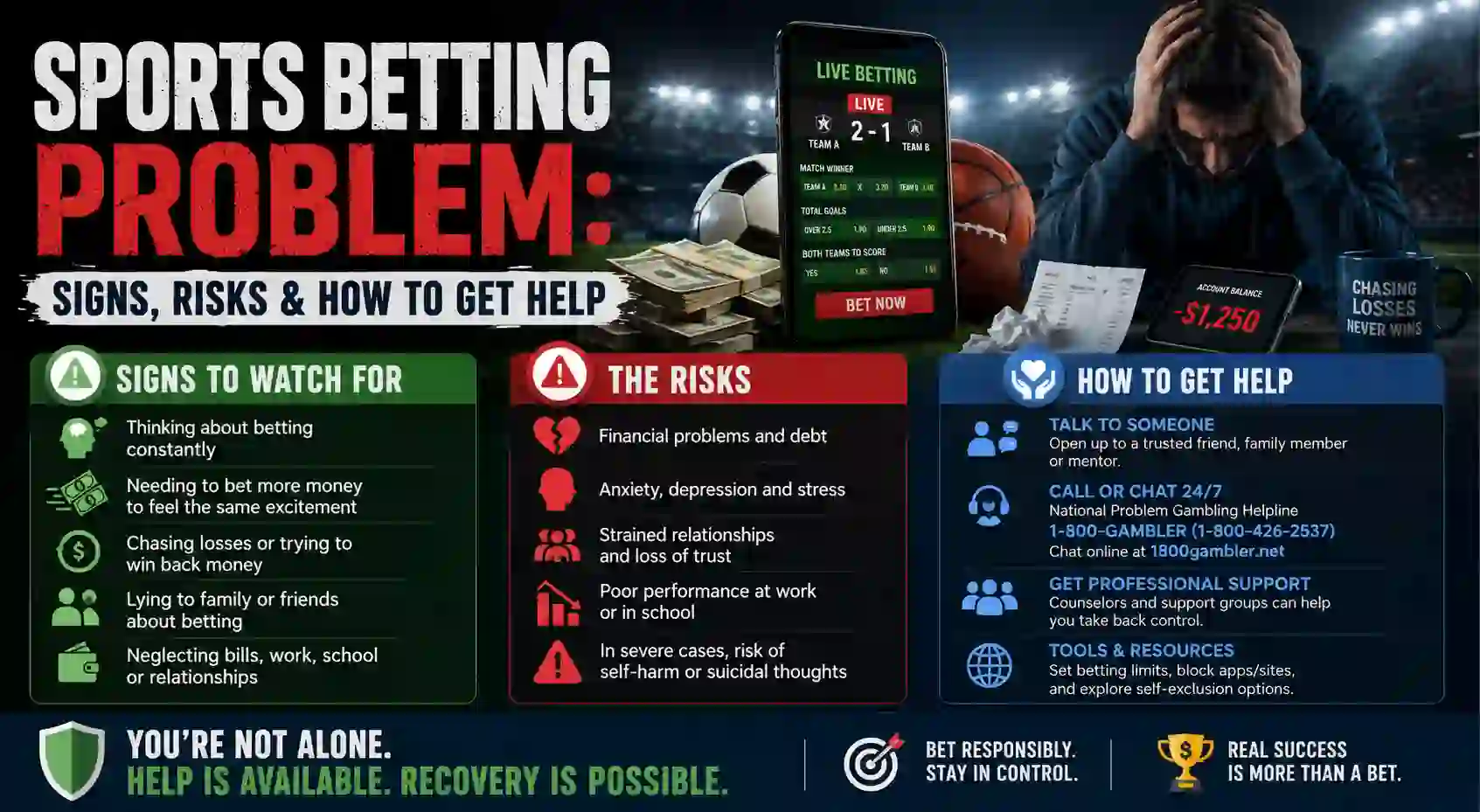
In practical terms, sports betting may be becoming harmful when a person repeatedly tries to stop but cannot, spends money intended for essential expenses, hides gambling from other people or continues betting despite debt, stress or relationship problems.
Sports betting can be particularly difficult to separate from everyday entertainment because betting opportunities are closely connected with live sport. Mobile apps also mean wagers can be placed before matches, during games and across numerous competitions without visiting a bookmaker.
The issue is therefore not simply how often someone bets, but whether betting is starting to control their decisions.
Sports Betting Problem vs Gambling Disorder
The terms “problem gambling”, “gambling harm” and “gambling disorder” are sometimes used interchangeably, but they are not exactly the same.
Gambling disorder is a recognised behavioural health condition. The WHO notes that it is classified alongside addictive disorders in the International Classification of Diseases, while gambling-related harm can occur at lower levels of gambling involvement.
Someone does not need a formal diagnosis before seeking support.
For example, a bettor who has started borrowing money, repeatedly chasing losses or experiencing arguments at home because of betting may already benefit from professional support even if they do not believe they have an “addiction.”
The NHS similarly advises that gambling can negatively affect relationships, physical and mental health, and finances.
Signs of a Sports Betting Problem
Problem betting often develops gradually. Because the person may still be working, socialising and managing some everyday responsibilities, the problem may initially be difficult for friends and relatives to recognise.
One important warning sign is preoccupation with betting. Instead of simply watching sport, someone may constantly check odds, research bets, calculate potential returns or plan the next wager.
GamCare identifies preoccupation as one of the common indicators of gambling harm. It also highlights withdrawal from normal activities, using gambling as an escape, chasing losses and lying about gambling as warning signs.
Chasing losses deserves particular attention.
Imagine losing £100 on a weekend of football. Instead of accepting the loss, a person decides that another £100 bet is necessary to “get even.” If that wager loses, the amount may increase again.
At that point, the motivation has changed. Betting is no longer primarily entertainment; it has become an attempt to repair previous gambling losses.
Other changes can also indicate trouble. A person may become irritated when unable to bet, stay awake late to gamble on competitions in different time zones, repeatedly deposit more money than planned or hide betting statements and transactions from their partner.
The NHS gambling screening questions include whether someone bets more than they can afford, needs larger stakes to obtain the same feeling, chases losses, borrows or sells possessions to gamble, experiences stress or anxiety because of gambling, encounters financial difficulties or feels guilty about their betting.
No single behaviour automatically proves that someone has a gambling disorder. However, several warning signs occurring together—or one behaviour causing serious harm—are good reasons to seek advice.
Why Sports Betting Can Become Difficult to Control
Sports betting can create a powerful sense of involvement because bettors often believe their sporting knowledge improves their chances.
Knowing a team’s injuries, recent performance, tactics or statistics can influence how a bettor evaluates an event. But knowledge does not remove uncertainty. Red cards, injuries, refereeing decisions, weather, unexpected performances and countless other variables can alter the outcome.
A person who is highly knowledgeable about sport can therefore still develop problematic gambling behaviour.
Another important factor is accessibility.
Online sportsbooks make betting available almost continuously. Someone can move from Premier League football in the afternoon to European competitions in the evening, American sports overnight and international events the following morning.
Live or in-play betting can create even more opportunities to make decisions during a single match.
The WHO identifies widespread online accessibility, high-speed wagering products and the increasing commercialisation and promotion of gambling as factors relevant to gambling-related harm.
For someone already struggling with control, constant access can make it much harder to create distance between an urge to gamble and the ability to place a wager.
The Financial Risks of Problem Sports Betting
Financial damage is one of the most visible consequences of harmful betting.
What begins as discretionary spending can eventually interfere with rent, mortgage payments, food, utilities, credit repayments or savings.
The situation can worsen quickly when someone begins chasing losses.
A person might initially decide that £20 is the maximum they are prepared to lose. After losing several bets, however, they may convince themselves that a larger wager will recover everything.
The new wager is then influenced by previous losses rather than the person’s original budget.
Borrowing money creates another level of risk. Credit, overdrafts, loans or money borrowed from family members can temporarily disguise gambling losses while increasing the person’s overall financial obligations.
The WHO identifies financial distress, poverty and the diversion of household money away from essential goods and services among the potential consequences of harmful gambling.
People experiencing gambling debt should address the underlying gambling behaviour as well as the debt itself. Simply refinancing or borrowing additional money may provide temporary relief without solving the reason the debt developed.
Mental Health and Emotional Risks
Problem sports betting can become emotionally exhausting.
Losses may produce guilt, frustration and anxiety. Winning can temporarily reduce those feelings, encouraging another betting session. Further losses then restart the cycle.
Over time, someone may experience difficulty sleeping, irritability, reduced concentration, anxiety about money or feelings of shame about hiding gambling from other people.
The NHS specifically notes that gambling problems can affect both physical and mental health.
At the most serious end of the spectrum, gambling-related harm can be associated with severe mental distress and suicide. The WHO identifies mental illness and suicide among the serious health harms associated with gambling.
That makes suicidal thoughts or feelings of hopelessness an emergency rather than simply another betting issue.
In the UK and Ireland, Samaritans can be contacted free on 116 123, 24 hours a day, 365 days a year. If someone’s life is in immediate danger in the UK, call 999 or go to an emergency department.
In the United States, the 988 Suicide & Crisis Lifeline is available by calling or texting 988 and provides free, confidential crisis support.
How Problem Betting Can Affect Relationships
Gambling harm rarely affects only the bettor.
Secrecy can be particularly damaging. Someone may understate how much they have lost, hide loans, delete gambling messages or give misleading explanations for missing money.
Eventually, the financial loss may become less damaging to a relationship than the repeated deception surrounding it.
Arguments can also develop around household spending, missed responsibilities or the amount of time devoted to gambling.
A person absorbed in betting may watch sport differently as well. Instead of enjoying a match with friends or family, their mood may depend heavily on whether a particular betting selection wins.
The WHO notes that gambling harm can contribute to relationship breakdown and can affect people beyond the individual who gambles.
Partners and family members can seek support themselves rather than waiting for the bettor to request treatment. NHS gambling services and charities can provide help to people affected by another person’s gambling.
When Sports Betting Stops Being Entertainment
One useful question is: What happens when you try not to bet?
Someone who occasionally bets for entertainment may be able to miss a weekend without much concern.
Someone developing a problem may find themselves repeatedly reinstalling betting apps, opening new accounts, searching for alternative ways to gamble or feeling unable to watch sport without placing a wager.
Another useful question is whether betting still fits comfortably within disposable income.
Money intended for housing, bills, food, debt payments or other essential expenses should not be treated as a betting bankroll.
The NHS specifically advises people experiencing gambling harm not to view gambling as a way of making money.
There is also an important psychological difference between accepting a loss and believing that the next bet must recover it.
The moment gambling becomes a solution to gambling losses, the risk of escalation increases.
How to Stop or Reduce Harmful Sports Betting
There is no single recovery strategy that works for everyone. However, combining professional support with practical barriers can make gambling more difficult during periods when urges are strongest.
Useful actions include:
- Tell someone you trust. Secrecy gives harmful gambling room to continue. Speaking with a partner, relative, friend, counsellor or gambling-support adviser can make the problem easier to address.
- Remove immediate access to betting. Delete sportsbook apps, unsubscribe from gambling marketing and remove saved payment information.
- Use self-exclusion. In Great Britain, GAMSTOP allows people to exclude themselves from gambling websites and apps operated by participating licensed businesses. Current options include six months, one year, five years and a five-year period with automatic renewal.
- Use gambling-blocking software. Software designed to block gambling websites and apps can create another barrier between an urge and a wager. GamCare lists gambling-specific blocking tools among the options available to people trying to control their gambling.
- Activate a bank gambling block. Many UK banks provide card controls designed to stop transactions categorised as gambling. GamCare recommends using these alongside measures such as self-exclusion and blocking software rather than relying on one barrier alone.
- Protect essential money first. Arrange important bills and essential payments before discretionary spending. The NHS recommends paying important household bills on payday and addressing gambling-related debts rather than ignoring them.
- Get professional support. Gambling treatment can help address triggers, distorted thinking, urges and the emotional circumstances surrounding gambling. The WHO reports that cognitive behavioural approaches and motivational interviewing have evidence supporting their use in treatment.
Creating several barriers at the same time is often more useful than expecting willpower alone to control every gambling urge.
Getting Help for a Sports Betting Problem in the UK
People in the UK have several routes into support.
The National Gambling Helpline, operated by GamCare, is available free on 0808 8020 133, 24 hours a day, seven days a week. Support is available for people concerned about their own gambling as well as relatives and friends affected by someone else’s behaviour.
Specialist NHS gambling treatment services are also available in England. The NHS states that people can self-refer to specialist gambling clinics or speak with their GP about services in their area. Clinics can provide treatment for gambling problems, associated complex health needs and support for relatives.
Support does not have to wait until someone has lost everything.
Contacting a service while the problem still seems “manageable” may prevent considerably greater financial and emotional harm later.
Getting Help for Problem Sports Betting in the United States
In the United States, the National Council on Problem Gambling operates the National Problem Gambling Helpline.
People can call or text 1-800-MY-RESET for support and connection with local gambling-related resources. The service covers all 50 states and U.S. territories and provides call, text and chat access 24/7/365.
The NCPG also makes clear that its gambling helpline is not an emergency service. Anyone experiencing an immediate mental health or suicide crisis should use an appropriate crisis service such as 988 or local emergency services.
People elsewhere should contact their national health service, licensed healthcare provider or recognised gambling-harm support organisation for local treatment options.
How to Help Someone With a Sports Betting Problem
Watching someone struggle with gambling can be frustrating, particularly when financial damage affects the wider household.
Conversations are generally more constructive when they focus on observable consequences rather than labels.
For example, discussing unpaid bills, repeated borrowing or changes in behaviour may be more useful than beginning with an argument over whether the person is “an addict.”
Avoid providing unlimited money to cover gambling losses without addressing the gambling itself. Constantly rescuing someone financially can unintentionally allow the behaviour to continue.
Family members should also protect their own finances where necessary and consider professional advice if joint debts, household bills or shared accounts are being affected.
Importantly, relatives can seek gambling-support services even when the person who gambles is unwilling to do so. GamCare and NHS services both provide support options for people affected by another person’s gambling.
Can Someone Recover From a Sports Betting Problem?
Yes. Gambling problems are treatable, and people can make meaningful changes to their gambling behaviour.
Recovery may involve stopping completely, professional therapy, peer support, financial restructuring, self-exclusion and technological barriers.
Progress is not necessarily identical for everyone.
Some people identify gambling triggers quickly, while others discover that betting has become connected with stress, loneliness, boredom, depression, sporting routines or financial pressures that also need attention.
The most important step is recognising that repeatedly trying to solve gambling losses through further gambling is unlikely to resolve the underlying problem.
Professional support provides an opportunity to understand what is driving the behaviour and create a more sustainable recovery plan.
FAQs
How do I know if I have a sports betting problem?
Consider whether you are spending more than you intended, repeatedly chasing losses, hiding your betting, borrowing money to gamble, becoming preoccupied with odds or finding it difficult to stop. Financial, emotional or relationship harm can justify seeking support even without a formal gambling-disorder diagnosis.
Is chasing losses a sign of problem gambling?
It can be an important warning sign. Chasing losses means continuing or increasing gambling in an attempt to recover previously lost money. GamCare and the NHS both identify chasing losses as a common indicator of gambling harm.
Can sports betting become addictive?
Yes. Gambling disorder is recognised as a behavioural disorder by major diagnostic systems, and sports betting is a form of gambling. Difficulty controlling betting, prioritising it over other areas of life and continuing despite harmful consequences are important warning signs.
Should I try to win my gambling losses back before quitting?
No. Trying to recover gambling losses by placing additional bets is chasing losses and can substantially worsen the financial situation. Treat previous losses as money already lost and focus instead on stopping further losses, protecting essential finances and obtaining support.
Can I block myself from betting websites?
Yes. In Great Britain, GAMSTOP provides self-exclusion from participating online gambling operators. Blocking software and bank gambling blocks can add further barriers.
Where can I get immediate help with problem gambling?
In the UK, the National Gambling Helpline is available through GamCare on 0808 8020 133, 24/7. In the United States, call or text 1-800-MY-RESET for the National Problem Gambling Helpline.
If gambling has contributed to suicidal thoughts or immediate danger, use emergency or crisis services rather than waiting for a gambling-support appointment.
Final Thoughts
A sports betting problem rarely disappears because of one successful accumulator, parlay, horse-racing bet or last-minute winner.
Winning may temporarily reduce financial pressure, but it can also reinforce the belief that gambling will solve problems created by gambling.
The healthier objective is not to get even with the bookmaker. It is to regain control of money, time, relationships and wellbeing.
If betting is causing anxiety, debt, secrecy, arguments or repeated attempts to recover losses, taking action now can prevent the situation from becoming more serious.
Professional treatment, confidential helplines, self-exclusion, gambling-blocking technology and financial safeguards are all available. The NHS emphasises that support and treatment are available for people experiencing gambling-related harm, while the WHO recognises gambling harm as an important public-health issue rather than simply a failure of individual willpower.
You do not need to wait until gambling reaches its worst possible point before asking for help.
ADVERTISEMENT

18+ | Affiliate link | Terms apply | Please gamble responsibly.


