Last Updated on September 27, 2026 by Maurya
Opening a sportsbook app for the first time during NFL season can feel like staring at a foreign language. Plus signs, minus signs, decimals, three-letter team codes, and a scrolling wall of numbers — all updating in real time. If that overwhelm sounds familiar, you’re in the right place.
This NFL betting guide for beginners breaks the entire process down into plain English. By the end, you’ll understand exactly how football odds work, the main types of bets you can place, how to manage your money so you don’t blow through your budget in week one, and the habits that separate disciplined bettors from people who treat the sportsbook like a slot machine.
Is NFL Betting Legal?
Legal, regulated sports betting has expanded rapidly across the United States, and the NFL is by far the most heavily wagered sport in the country. That said, availability depends entirely on where you live. Some states offer full online and mobile betting, some allow only in-person wagering at licensed venues, and others still prohibit it altogether.
Before you deposit a dollar, confirm two things: that betting is legal in your jurisdiction, and that the sportsbook you’re using is licensed and regulated by your state’s gaming authority. Licensed books are legally required to protect your funds, pay out winnings, and offer responsible-gambling tools. Offshore or unlicensed sites offer none of those protections — avoid them.
You must also be of legal betting age, which is 21 in most U.S. states (18 in a handful). The sportsbook will verify your identity during sign-up.
How NFL Betting Odds Work
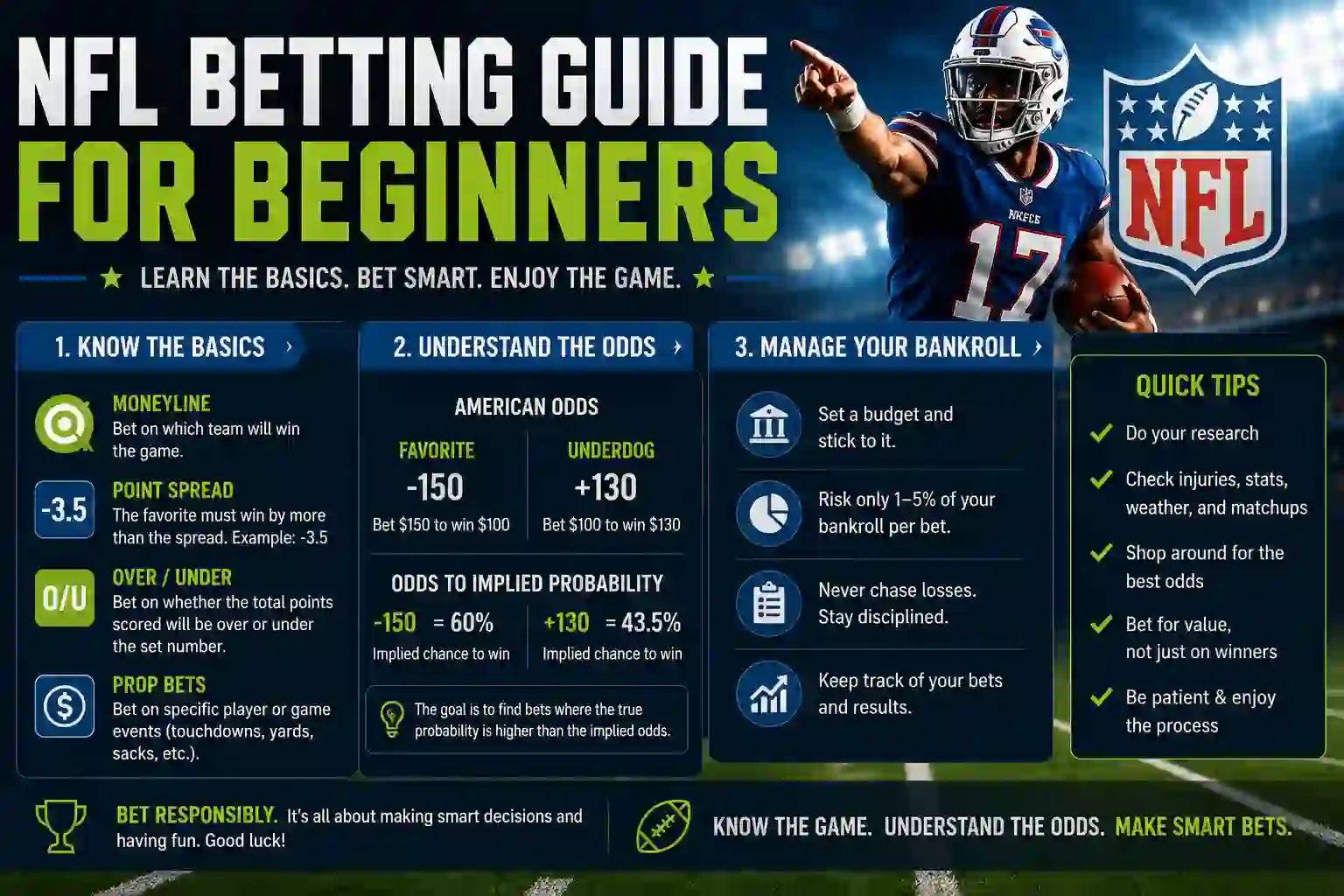
Everything in NFL betting flows from one concept: odds. Odds tell you two things — how much you’ll win on a successful bet, and the implied likelihood of that outcome. In the U.S., odds are usually displayed in the American (moneyline) format, which uses positive and negative numbers.
Negative odds (favorites)
A minus sign marks the favorite — the team more likely to win. The number tells you how much you need to stake to win $100.
- Example: A team listed at -150 means you must bet $150 to win $100 in profit (returning $250 total).
Positive odds (underdogs)
A plus sign marks the underdog. The number tells you how much profit you’ll win on a $100 stake.
- Example: A team listed at +130 means a $100 bet wins $130 in profit (returning $230 total).
You don’t have to bet in $100 increments — that’s just the reference point the format uses. The payout scales to whatever you actually wager.
Implied probability
Odds also reflect a probability. You can roughly convert them:
- Favorites: odds ÷ (odds + 100). So -150 implies 150 ÷ 250 = 60%.
- Underdogs: 100 ÷ (odds + 100). So +130 implies 100 ÷ 230 ≈ 43.5%.
Notice those two add up to more than 100%. That extra slice is the sportsbook’s commission — more on that next.
The “vig” (how the sportsbook makes money)
The vig (short for vigorish, also called “juice”) is the small fee baked into every line. It’s why most point-spread and totals bets are priced at -110 on both sides: you risk $110 to win $100 either way. That extra $10 is the book’s margin, and over thousands of bets it’s how sportsbooks stay profitable. Understanding the vig is the first step toward thinking like a sharp bettor rather than a casual one — because beating the book means overcoming that built-in edge.
The Main Types of NFL Bets
There are dozens of ways to bet on a football game, but beginners only need to master a handful. Start here.
- Moneyline
The simplest bet in football: pick who wins the game outright. No margins, no spreads — just the winner. Favorites carry negative odds (lower payout, higher chance), underdogs carry positive odds (higher payout, lower chance). Moneyline bets are a great starting point because the logic is intuitive.
- Point Spread
The point spread is the most popular way to bet on the NFL, because it levels the playing field between mismatched teams. Instead of just picking a winner, you bet on the margin of victory.
The favorite is given a handicap (e.g., -7), and the underdog gets a head start (e.g., +7).
- If you bet the favorite at -7, they must win by more than 7 points for you to cash.
- If you bet the underdog at +7, they can lose by 6 or fewer, or win outright, and you still win.
If the favorite wins by exactly 7, the result is a push — a tie — and your stake is refunded.
- Totals (Over/Under)
A total has nothing to do with who wins. The sportsbook sets a number for the combined points scored by both teams — say, 44.5 — and you bet whether the real total will go over or under that line. A defensive slugfest goes under; a shootout goes over. Totals are popular because you can root for both offenses (or both defenses) regardless of the outcome.
- Prop Bets (Proposition Bets)
Props are wagers on specific events within a game rather than the final result. They come in two flavors:
- Player props: Will the quarterback throw for over 275.5 yards? Will the running back score a touchdown?
- Team/game props: Which team scores first? Will there be a score in the final two minutes?
Props are fun and let you bet on the parts of football you follow most closely, but lines can be sharp — bet them selectively.
- Parlays
A parlay combines two or more bets into one ticket. The catch: every single leg must win for the parlay to pay out. The upside is a much larger payout, because the odds of each leg multiply together. The downside is that one wrong pick sinks the whole thing.
Parlays are exciting and the potential returns look tempting, but they carry a significantly higher house edge than single bets. Treat them as occasional, low-stake lottery tickets — not a core strategy.
- Teasers
A teaser is a parlay variant that lets you adjust the point spread or total in your favor across multiple games — for example, moving two spreads by 6 points each. In exchange for those friendlier numbers, you accept a lower payout, and you still need every leg to hit.
- Futures
Futures are long-term bets on outcomes decided down the road: who wins the Super Bowl, which player takes MVP, how many games a team will win this season. Odds shift throughout the year as the picture changes. Futures tie up your money for weeks or months, but they add a season-long rooting interest.
- Live (In-Game) Betting
Live betting lets you wager while the game is happening, with odds updating play by play. You might grab a better spread after a slow start or bet the over once a shootout takes shape. It’s fast-paced and engaging — but the speed also makes it easy to over-bet, so tread carefully as a beginner.
How to Read an NFL Betting Line
Once you know the bet types, a sportsbook screen stops looking like noise. Here’s a typical line:
| Team | Spread | Total | Moneyline |
| Team A | -3.5 (-110) | O 47.5 (-110) | -180 |
| Team B | +3.5 (-110) | U 47.5 (-110) | +155 |
Reading across: Team A is a 3.5-point favorite (must win by 4+), priced at -110. The game total is 47.5 points. Team A is a -180 moneyline favorite, meaning you’d risk $180 to win $100. Team B is the +3.5 underdog and pays +155 on the moneyline. That’s the whole grid — three core markets, side by side.
Bankroll Management
Here’s the part most beginners skip and most experienced bettors swear by. You can pick winners at a respectable clip and still go broke if you bet recklessly. Bankroll management is the discipline that keeps you in the game.
Set a dedicated bankroll
Your bankroll is money set aside specifically for betting — never rent, bills, or savings. Decide on an amount you’re completely comfortable losing, and treat it as the cost of entertainment, like a night out.
Bet in units, not feelings
Instead of wagering wildly different amounts based on how confident you feel, use a unit system. One unit is a small, fixed percentage of your bankroll — commonly 1% to 5%.
- With a $500 bankroll and a 2% unit, one unit is $10.
- A standard play might be 1 unit; a strong play, 2 units. Rarely, if ever, more.
This keeps a few bad beats from wiping you out and removes emotion from how much you risk.
Never chase losses
The single most destructive habit in betting is chasing — placing bigger, riskier bets to win back what you just lost. It’s how a small bad night becomes a disaster. If you hit your loss limit for the day, stop. The games will still be there tomorrow.
Keep records
Track every bet: the wager, the odds, the result. Over time, your records reveal what’s working, what isn’t, and whether you’re being honest with yourself about results. Memory tends to inflate the wins and forget the losses.
Beginner Strategy Tips
You won’t beat the sportsbook overnight, but a few disciplined habits will make you a sharper, more sustainable bettor than the average fan throwing money at their favorite team.
Shop for the best line. The same game is often priced slightly differently across sportsbooks. Having accounts at two or three licensed books lets you grab the best available number — and over a season, those half-points genuinely add up.
Bet with your head, not your heart. Wagering on your favorite team clouds judgment. Many disciplined bettors avoid betting on teams they’re emotionally attached to entirely.
Understand “value,” not just winners. Smart betting isn’t about picking who wins — it’s about finding odds that pay more than the true probability of an outcome. A team can be likely to win and still be a bad bet if the price is too steep.
Do a little homework. Injuries (especially at quarterback), weather, travel, rest, and matchups all move the needle in the NFL. You don’t need to be an analyst, but checking the injury report before you bet is the bare minimum.
Start small and slow. Stick to straightforward single bets — moneylines, spreads, and totals — until the mechanics feel like second nature. The exotic stuff can wait.
Avoid the rookie traps: betting too many games at once, loading up on long-shot parlays, drinking and betting, and assuming a team that’s lost several in a row is “due.” None of these are strategies — they’re just ways to lose faster.
Responsible Gambling
This is the most important section in the entire guide. Betting on the NFL should be entertainment — a way to add excitement to the games — and nothing more. It is not an income source, an investment, or a way out of financial trouble.
Build these guardrails from day one:
- Set time and money limits before you bet, and stick to them no matter how the day is going.
- Use the tools your sportsbook provides — deposit limits, loss limits, time-outs, and self-exclusion options exist for exactly this reason.
- Never gamble to escape stress, sadness, or boredom, and never bet under the influence.
- Don’t borrow money to bet, and never try to win back losses with the rent.
Know the warning signs of a problem: betting more than you can afford, chasing losses, lying about how much you wager, feeling anxious or irritable when you’re not betting, or letting it interfere with work, sleep, or relationships.
If betting ever stops feeling fun — or if you recognize any of those signs in yourself or someone you know — help is free, confidential, and available 24/7. In the U.S., call or text the National Problem Gambling Helpline at 1-800-GAMBLER, or visit the National Council on Problem Gambling (ncpgambling.org). There’s no shame in reaching out, and doing so early makes all the difference.
How to Choose a Sportsbook
When you’re ready to sign up, weigh a few factors beyond flashy promotions:
- Licensing: Only use books regulated in your state. This is non-negotiable.
- Odds quality: Slightly better pricing matters far more over time than a one-time sign-up bonus.
- Usability: A clean, reliable app makes betting (and not over-betting) easier.
- Banking: Fast, transparent deposits and withdrawals.
- Responsible-gambling tools: Robust limit-setting and self-exclusion features are a sign of a trustworthy operator.
Read the fine print on any “bonus” or “free bet” offer — they almost always carry wagering requirements and conditions that aren’t as generous as the headline suggests.
FAQs
How much money do I need to start betting on the NFL?
Less than you might think. Many sportsbooks let you bet just a dollar or two. Start with an amount you’re entirely comfortable losing — for many beginners that’s $20 to $50 — and use small, consistent unit sizes rather than chasing big plays.
What’s the easiest NFL bet for beginners?
The moneyline is the most beginner-friendly bet — you simply pick who wins the game. The point spread is the most popular and worth learning early, since it’s central to how football is bet.
What does -110 mean in betting?
It means you risk $110 to win $100. That extra $10 is the sportsbook’s commission (the “vig”), and -110 is the standard price on most point-spread and totals bets.
Are NFL parlays a good idea for beginners?
Parlays are fun and pay big, but they carry a much higher house edge because every leg must win. Treat them as occasional, low-stake bets — not your main strategy. Single bets give you better long-term odds.
Can you actually make money betting on the NFL?
A small number of disciplined bettors are profitable long term, but it’s genuinely difficult — the sportsbook’s built-in edge means most people lose over time. Approach NFL betting as paid entertainment, never as a reliable income source.
The Bottom Line
NFL betting is far more approachable than that first wall of numbers makes it look. Learn how American odds work, get comfortable with the core bet types — moneyline, point spread, and totals — and treat bankroll management and responsible gambling as the foundation everything else sits on. Master those fundamentals, stay disciplined, keep your stakes small, and your wagers will become exactly what they should be: a fun, low-risk way to make Sundays more exciting.
Bet smart, set your limits, and never wager more than you can afford to lose.


