

18+ | Affiliate link | Terms apply | Please gamble responsibly.
Last Updated on October 2, 2026 by Maurya
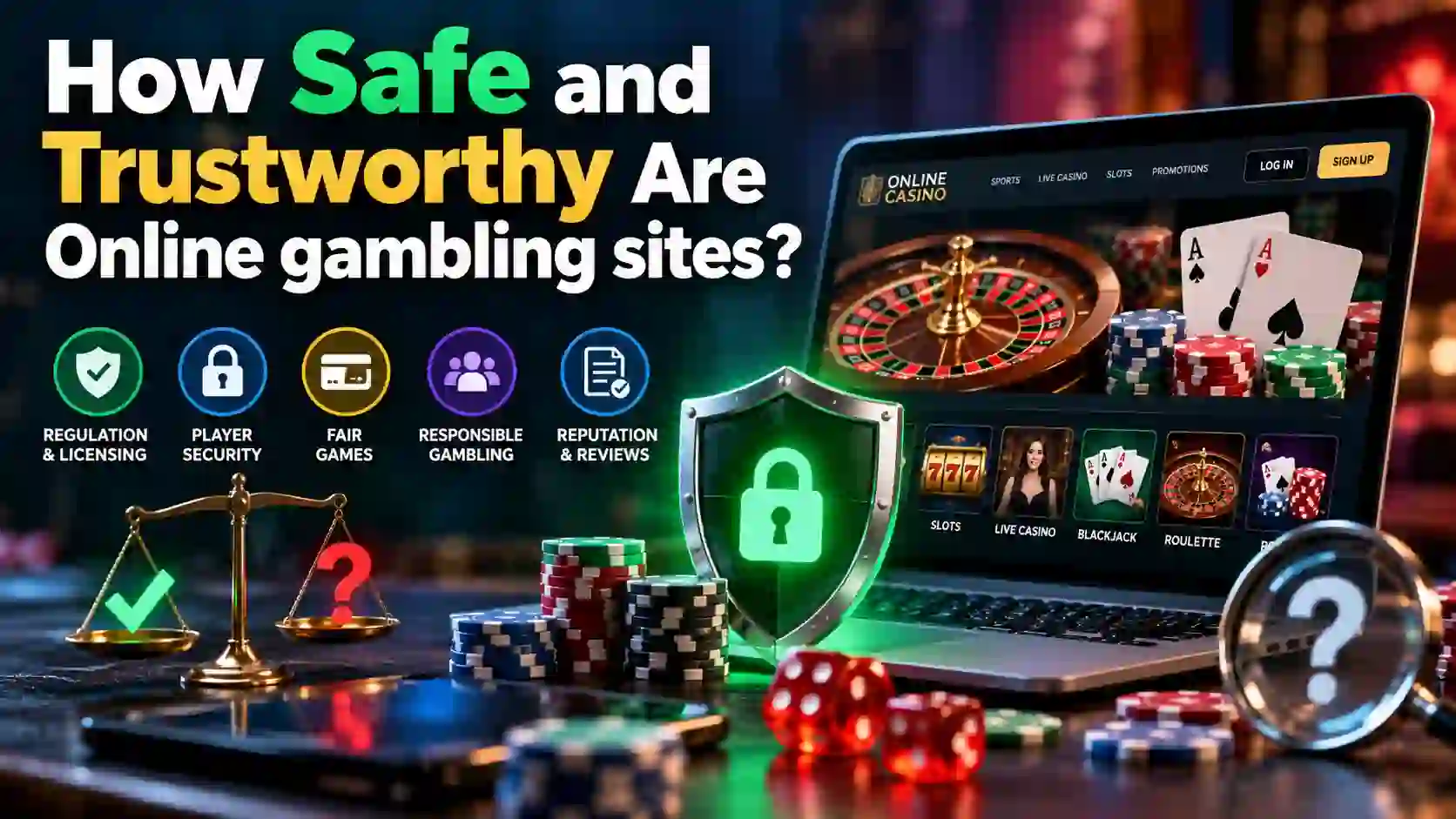
Online gambling has become increasingly sophisticated. Modern betting and casino websites can offer encrypted payments, professionally designed mobile apps, thousands of games and near-instant account registration. But appearance alone tells you almost nothing about whether an online gambling site is genuinely safe.
So, how safe and trustworthy are online gambling sites?
The answer is that some online gambling sites operate under strict regulatory, technical and consumer-protection requirements, while others may operate with weak oversight—or without a legitimate licence at all.
A trustworthy gambling site should be able to demonstrate who regulates it, who owns it, how customer money is handled, how games are tested, how personal information is protected and what happens when a player raises a dispute.
Players should therefore judge an online gambling site by verifiable evidence rather than advertising claims, bonus offers or professional-looking website design.
Are Online Gambling Sites Safe?
Licensed online gambling sites can provide significant consumer protections, but no gambling website should automatically be considered safe simply because it operates online.
The strongest protection normally comes from gambling sites licensed by a recognised regulator in the jurisdiction where the player is located.
For example, companies offering gambling to consumers in Great Britain must normally be licensed by the UK Gambling Commission. The Commission maintains a public register where consumers can search by company name, trading name or domain name and check whether a licence is active. The register also provides information about regulatory action taken against operators.
Malta’s regulator, the Malta Gaming Authority, similarly maintains a searchable licensee register and an enforcement register. It also publishes warnings about URLs falsely claiming an association with the MGA.
That distinction matters because legitimate licensing creates accountability. An operator may have to comply with rules covering areas such as:
- customer identification;
- age verification;
- fair gaming;
- complaints;
- responsible gambling;
- customer funds;
- anti-money-laundering procedures;
- technical systems;
- advertising; and
- regulatory reporting.
The exact protections differ by country and regulator, so players should always verify which laws apply where they live.
Start by Checking the Gambling Licence
A gambling licence is one of the most important trust signals—but it must be independently verified.
Do not simply accept a logo in the website footer stating “Licensed and Regulated.”
Fraudulent websites can copy regulator logos, licence numbers and certification badges.
Instead, find the legal company name and licence information on the gambling website and then search the regulator’s official database independently.
For British consumers, the UK Gambling Commission specifically recommends checking whether a gambling company is licensed before gambling. Its public register can show the business’s current licence status, approved trading names, domains and any published regulatory action.
A trustworthy gambling website should therefore make it reasonably easy to identify:
Legal company name: Who actually operates the website?
Licence number: Is a regulator-issued licence number provided?
Regulator: Which authority supervises the company?
Licensed domain: Does the domain you are visiting match the domain listed by the regulator?
Licence status: Is the licence currently active?
Enforcement history: Has the regulator published sanctions or other actions concerning the operator?
The domain check is particularly important. A fraudulent site may copy the name of a licensed business while operating through a completely different website address.
Does Regulation Guarantee a Gambling Site Is Safe?
No.
Licensing is an important protection, but it is not an absolute guarantee that nothing will ever go wrong.
Licensed operators can experience technical problems, customer-service failures, payment disputes or regulatory breaches. Regulators can investigate operators and impose regulatory action when appropriate.
A licence should therefore be viewed as the starting point of due diligence rather than the end of it.
Look at the complete picture:
- licence verification;
- ownership transparency;
- regulatory history;
- financial protections;
- game testing;
- security standards;
- withdrawal rules;
- responsible-gambling features; and
- complaint procedures.
A website satisfying several independent checks is considerably easier to assess than one relying only on marketing claims.
Check Whether Casino Games Are Independently Tested
One common concern is whether online casino games can be manipulated.
At properly regulated sites, random games are normally subject to technical requirements designed to ensure that outcomes operate as intended.
The UK Gambling Commission’s Remote Gambling and Software Technical Standards require random number generation and game results to be “acceptably random.” The Commission states that randomness should be capable of being demonstrated to a high degree of confidence through recognised testing and analysis.
The Commission also requires certain gambling products to undergo testing by approved test houses. Its testing procedures can include reviewing RNG software, source code, statistical outputs, game mathematics, theoretical Return to Player figures and actual game behaviour.
For specified products, new games must be adequately tested before release, with independent third-party assurance forming part of the regulatory testing framework.
This does not mean players are expected to win. Casino games are mathematically designed to give the operator an advantage over time.
Fairness means the game operates according to its disclosed design and applicable rules—not that every player receives equal wins and losses.
What Is RTP?
RTP, or Return to Player, is the theoretical percentage of wagered money that a game is designed to return to players over a very large number of plays.
It should not be interpreted as a promise about an individual gambling session.
For example, a theoretical RTP percentage describes long-term game mathematics. One player can lose substantially more or win substantially more over a short session.
A credible operator should make relevant game rules and information accessible rather than suggesting that particular outcomes are guaranteed.
Payment Security Is Another Major Trust Factor
Online gambling sites handle sensitive financial information, making payment security essential.
One recognised security framework is the Payment Card Industry Data Security Standard (PCI DSS).
According to the PCI Security Standards Council, PCI DSS establishes technical and operational requirements designed to protect payment-account data for organisations that store, process or transmit cardholder information.
Its requirements cover areas including network security, access controls and the protection of stored and transmitted payment information.
However, seeing “PCI compliant” in marketing materials should not be treated as proof of overall gambling-site trustworthiness.
Payment security is only one element.
A safe gambling site should also have appropriate controls around:
- account passwords;
- login security;
- personal information;
- identity documents;
- withdrawals;
- suspicious account activity; and
- access to customer accounts.
Two-factor authentication, where available, can add another layer of account security.
Players should also use unique passwords rather than reusing a banking, email or social-media password on a gambling account.
HTTPS Is Necessary but Not Proof of Legitimacy
A secure gambling site should use HTTPS encryption.
You can normally identify this through the secure connection indicator in your browser and a URL beginning with https://.
Encryption helps protect data transmitted between your browser and the website.
But there is an important limitation:
HTTPS does not prove that the company operating the website is trustworthy.
Scam websites can also obtain encryption certificates.
Treat HTTPS as a minimum technical requirement, not an endorsement.
Regulatory verification remains much more important.
Understand How the Site Protects Player Funds
Many players assume money held in a gambling account is protected in the same way as money held in a bank account.
That assumption can be wrong.
In Great Britain, the Gambling Commission makes clear that money deposited with a gambling business is not protected by the Commission or government in the same way as personal bank deposits.
Licensed operators holding customer money must disclose their arrangements for protecting those funds if the business becomes insolvent.
The Commission uses three customer-fund protection categories:
- Not protected
- Medium protection
- High protection
Remote operators that hold customer funds must keep them separate from their normal business accounts, but the Commission explains that segregation alone does not necessarily guarantee repayment if the operator becomes insolvent.
Since 31 October 2025, British operators with a “not protected” rating have also been required to remind customers every six months about that lack of insolvency protection where they continue to hold customer funds.
Before maintaining a large gambling-account balance, therefore, check the site’s terms to understand what would happen to your money if the business failed.
Reliable Gambling Sites Verify Age and Identity
Some players regard identity verification as an inconvenience. In a properly regulated environment, however, verification can be a sign that an operator is complying with legal and regulatory requirements.
The UK Gambling Commission states that online gambling businesses must verify a customer’s age and identity before allowing them to gamble.
Verification may involve electronic databases or documents such as a passport, driving licence or household bill.
Additional information can sometimes also be requested for legal or anti-money-laundering purposes.
What should raise concern is an operator that repeatedly delays reasonable verification until a customer tries to withdraw money when the information could have been requested earlier.
The Gambling Commission specifically states that identity checks should not simply be postponed until withdrawal when the operator could reasonably have completed them earlier.
Read the Withdrawal Rules Before Depositing
Withdrawal problems are among the issues that can cause disputes between gambling websites and customers.
Before depositing money, check:
Minimum withdrawal: Is there a minimum amount?
Maximum withdrawal: Are daily, weekly or monthly caps imposed?
Processing time: How long does the operator say withdrawals normally take?
Verification: Which documents may be required?
Payment method: Must money normally return through the same payment method used to deposit?
Bonus conditions: Can a promotion restrict the withdrawal of bonus-related funds?
Account status: Can withdrawals be delayed for legitimate regulatory checks?
Clear rules do not necessarily mean every withdrawal will be instant. Identity, security or anti-money-laundering reviews can sometimes delay payment.
However, vague terms, constantly changing explanations or demands for additional deposits before releasing genuine winnings are serious warning signs.
Read Bonus Terms Carefully
Large bonuses can make a gambling site look attractive, but bonuses should never determine whether a site is considered trustworthy.
Promotions may come with:
- wagering requirements;
- qualifying-game restrictions;
- minimum odds;
- maximum stake conditions;
- expiry periods;
- withdrawal limits; or
- eligibility requirements.
The key trust factor is transparency.
Terms should be accessible before accepting the promotion and written clearly enough for an ordinary customer to understand the significant conditions.
Treat promises of “guaranteed wins,” “risk-free gambling” or unusually easy profits with extreme caution.
Legitimate gambling remains gambling; outcomes cannot sensibly be represented as guaranteed income.
Responsible-Gambling Tools Are an Important Safety Signal
A trustworthy licensed operator should acknowledge that gambling can cause harm.
Responsible-gambling tools can include:
- deposit limits;
- loss or stake limits;
- reality checks;
- session reminders;
- cooling-off periods;
- time-outs;
- self-exclusion; and
- transaction histories.
In Great Britain, rules effective from 30 September 2026 require online operators to offer gross deposit limits and reserve the term “deposit limit” for that specific type of limit. The rules are intended to provide consumers with clearer, more consistent financial-limit tools.
Licensed systems must also make financial-limit facilities easily accessible and prompt customers to consider setting a financial limit during registration or when making their first deposit.
The Malta Gaming Authority likewise requires licensed operators to provide player-protection information and safer-gambling tools and says players should not be encouraged to chase losses, gamble beyond what they can afford or engage in prolonged continuous play.
These features matter because safety involves more than cybersecurity. It also involves how the operator responds to the inherent risks associated with gambling.
Check the Complaints Procedure
Even reputable businesses occasionally have disputes with customers.
A trustworthy operator should explain:
- how to make a complaint;
- where to send it;
- how long an investigation may take;
- how decisions are communicated; and
- how an unresolved dispute can be independently escalated.
In Great Britain, licensed operators must maintain fair, open and transparent complaints procedures.
If a dispute cannot be resolved through the operator’s process, customers can potentially refer eligible disputes to an independent Alternative Dispute Resolution provider. The Gambling Commission says the operator’s complaint process must take no longer than eight weeks, although it may conclude earlier.
A site with no identifiable complaints procedure or independent escalation mechanism deserves extra scrutiny.
Research the Operator, Not Just the Brand
A gambling brand and the company operating it are not necessarily the same thing.
Before trusting a site, identify its legal owner.
Useful questions include:
- How long has the company operated?
- Which regulator licenses it?
- Does it operate several gambling brands?
- Is its registered company name clearly disclosed?
- Has its regulator published enforcement action against it?
- Are the website and licence details consistent?
Regulatory databases are generally more reliable for this purpose than anonymous reviews.
User reviews can highlight recurring customer-service experiences, but they should be treated as supplementary evidence. Reviews can be fake, manipulated, outdated or based on misunderstandings.
When reviewing complaints, patterns are more meaningful than isolated comments.
Repeated reports involving unpaid balances, inaccessible accounts, unclear bonus terms or unexplained withdrawal delays deserve investigation.
Common Warning Signs of an Unsafe Gambling Site
No single red flag proves a site is fraudulent, but several warning signs together should significantly increase caution.
No Verifiable Licence
If the operator claims to be licensed but does not appear on the regulator’s official register, do not rely on the site’s claim.
Fake Regulatory Logos
A licence logo should link back to genuine regulatory information or be independently verifiable.
No Legal Company Information
A gambling website should not make it difficult to determine who owns and operates it.
Unclear Withdrawal Conditions
Withdrawal procedures should not be hidden or deliberately confusing.
Requests to Pay a “Release Fee”
Be extremely cautious if an operator unexpectedly demands additional money before releasing a balance or supposed winnings.
Cryptocurrency-Only Payments With No Clear Regulation
Cryptocurrency itself does not prove fraud. However, an anonymous operator accepting irreversible payments while providing no verifiable licensing or company details presents additional risk.
Guaranteed-Profit Claims
Casino games and betting involve uncertainty. A site promising guaranteed gambling profits should immediately raise concern.
Poor Website Security
Browser security warnings, broken certificates or suspicious redirects should not be ignored.
No Responsible-Gambling Information
The absence of meaningful player-protection information is another warning sign, particularly where the operator claims to be regulated by a jurisdiction that requires such safeguards.
Aggressive Marketing
Pressure to deposit immediately, recover previous losses or continue gambling should not be viewed as a positive sign.
A Practical Online Gambling Safety Checklist
Before depositing with an online gambling site, perform the following checks:
- Find the licence information.
Identify the regulator, licence number and legal company. - Verify it independently.
Search the regulator’s official register instead of trusting the site’s logo. - Confirm the exact domain.
Make sure the website address matches the authorised domain. - Check regulatory history.
Look for published enforcement actions where a regulator provides them. - Review the terms and conditions.
Pay particular attention to withdrawal, verification and promotional rules. - Check customer-fund protection.
Understand what happens to your account balance if the operator becomes insolvent. - Review payment security.
Look for encrypted connections and established payment methods. - Check game-testing information.
Regulated gambling software should operate under appropriate technical and fairness requirements. - Find responsible-gambling tools.
Limits, time-outs and self-exclusion features should be easy to locate. - Find the complaint process.
Know how disputes can be escalated before money is deposited.
Completing these checks takes longer than simply choosing the first result in a search engine, but they provide substantially more useful information about whether an online gambling site deserves trust.
FAQs
Are Online Gambling Sites Legitimate?
Some are, while others are not. Legitimate online gambling sites should operate under the laws applicable to their target market and make their licensing and company information verifiable through an official regulator.
Always verify a site’s licence independently.
How Can I Tell if an Online Casino Is Safe?
Check its regulatory licence, legal company, domain, game-testing requirements, payment security, customer-fund protections, withdrawal terms, safer-gambling tools and complaint procedure.
No single badge should be treated as enough evidence by itself.
Can Online Casinos Rig Their Games?
Regulated operators must comply with technical standards governing game fairness. In Great Britain, for example, relevant RNG-based gambling products are subject to technical requirements and independent testing arrangements.
Unregulated sites may not provide equivalent oversight, which is why licensing verification is important.
Are Gambling Winnings Guaranteed to Be Withdrawable?
A legitimate balance should be handled according to the operator’s terms and applicable laws, but withdrawals can legitimately be delayed for security, identity or legal checks.
Players should read withdrawal and verification rules before depositing and retain copies of relevant communications when a dispute arises.
Is a Gambling Licence Enough to Trust a Website?
Not entirely.
A valid licence is one of the strongest initial indicators of accountability, but consumers should also consider regulatory history, fund protection, security, transparent terms and complaint procedures.
Why Do Gambling Websites Ask for ID?
Regulated businesses may need to verify age and identity, prevent underage gambling, meet anti-money-laundering requirements and comply with other legal duties.
In Great Britain, age and identity verification is required before online gambling takes place.
Is It Safe to Leave Money in an Online Gambling Account?
That depends partly on the operator’s customer-fund arrangements.
Gambling balances should not automatically be viewed like protected bank deposits. Check the operator’s insolvency-protection disclosures and avoid assuming money is guaranteed if the business fails.
Final Thoughts
Online gambling sites vary significantly in safety and trustworthiness.
A well-regulated operator can offer meaningful protections through verified licensing, identity controls, independent game testing, secure payment systems, customer-fund arrangements, responsible-gambling tools and formal dispute procedures.
But none of those measures make gambling financially risk-free.
The best way to evaluate an online gambling site is to verify rather than assume.
Start with the regulator. Confirm the licence and exact website domain. Investigate who owns the platform, understand how your money is protected, read withdrawal and promotional terms, check how games are tested and make sure there is a credible complaints process.
Above all, do not confuse an attractive website, large welcome bonus or impressive advertisement with evidence of trustworthiness.
The safest approach is to use independently verifiable information from regulators and recognised security standards—and to avoid any gambling operator whose identity, licence or rules cannot be clearly confirmed.
ADVERTISEMENT

18+ | Affiliate link | Terms apply | Please gamble responsibly.


