Last Updated on September 27, 2026 by Maurya
Online gambling has grown from a niche pastime into a global industry generating well over US$95 billion in annual online revenue, with Europe alone accounting for roughly 40% of that figure. That explosive growth — driven by smartphones, frictionless payments, and live in-play betting — has forced governments worldwide to answer a difficult question: how do you regulate an activity that lives on the borderless internet, where an operator licensed in one country can reach a player in another with a single click?
Why Governments Regulate Online Gambling
Before looking at the how, it helps to understand the why. Governments do not regulate online gambling for a single reason — they do it to balance several competing public interests at once.
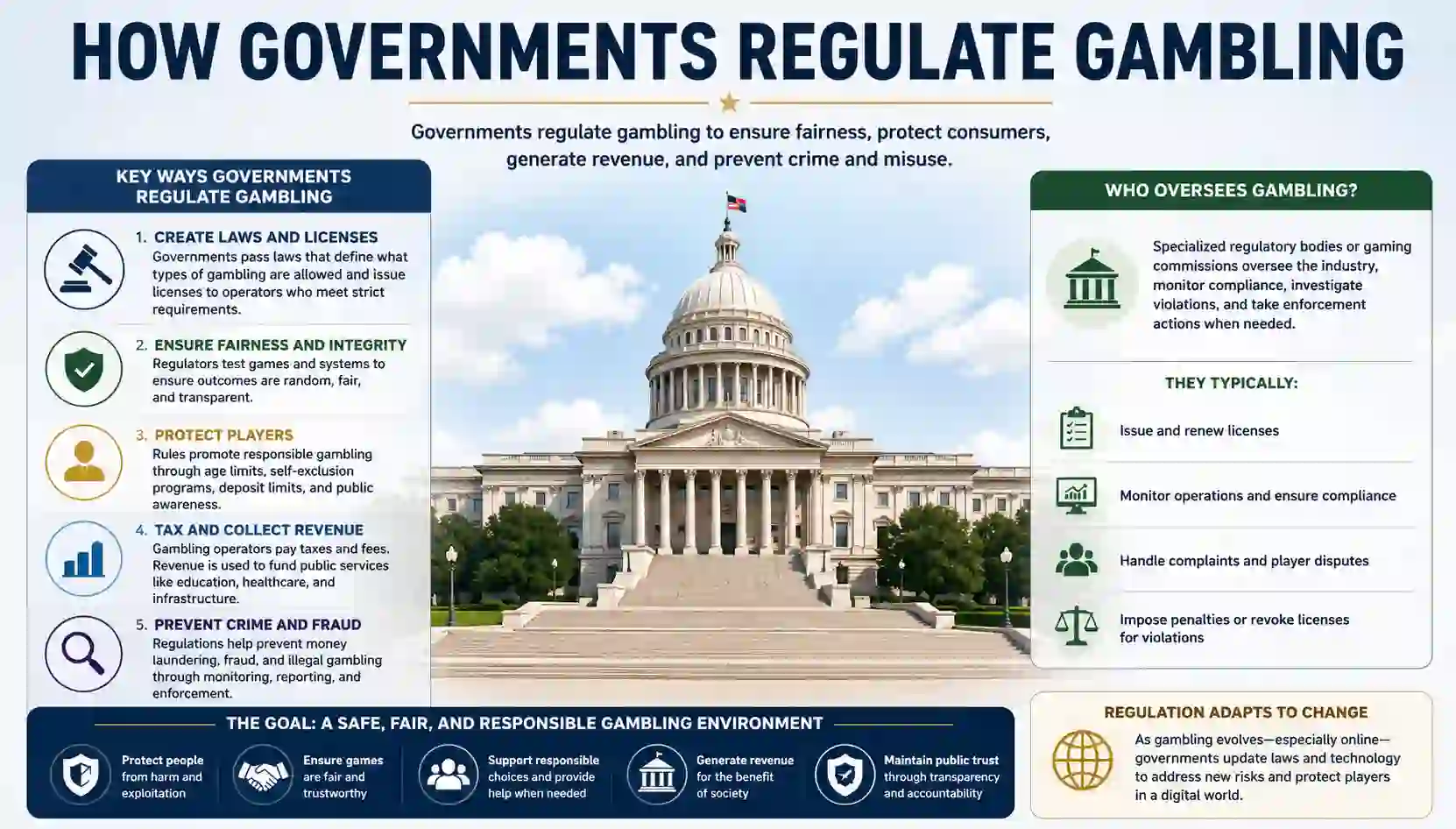
The first and most important is consumer protection. Regulators want to ensure that games are fair, that advertised odds are honest, that customer funds are safe, and that vulnerable people are shielded from gambling-related harm and addiction. The second is crime prevention: online platforms move enormous sums of money quickly, making them attractive vehicles for money laundering, fraud, and match-fixing if left unchecked. Third, governments aim to protect minors and at-risk individuals, keeping under-age users off platforms entirely. Fourth, regulation generates significant tax revenue, which often funds public services and harm-prevention programmes. Finally, oversight preserves market integrity, giving legitimate operators a level playing field and giving the public confidence that the system is not rigged.
Every regulatory tool described below traces back to one or more of these objectives.
The Core Pillars of Online Gambling Regulation
While the details differ from country to country, almost every regulatory regime is built on the same set of pillars:
- Licensing — operators must be authorised before they can legally offer services.
- Age and identity verification (KYC) — confirming who players are and that they are old enough.
- Responsible (safer) gambling — tools and rules that reduce harm.
- Anti-money laundering (AML) — financial controls to stop dirty money.
- Taxation — duties on operators and, in some cases, on winnings.
- Advertising standards — limits on how gambling can be marketed.
- Technical standards — ensuring games are fair and systems are secure.
Let’s examine each in turn.
- Licensing and Operator Authorisation
Licensing is the foundation of online gambling regulation. A licence is, in effect, legal permission to operate — and obtaining one is rarely easy. Before issuing a licence, a regulator typically vets an operator’s financial stability, technical capability, and the integrity and background of its owners and key personnel. The goal is to ensure that only credible, well-run businesses can take bets from the public.
There are two broad models. Some jurisdictions use a centralised national system with a single regulator, such as the UK Gambling Commission (UKGC) or the Malta Gaming Authority (MGA). Others, most notably the United States, use a decentralised state-by-state model in which there is no national gambling licence at all — each state runs its own commission, sets its own rules, and issues its own permits. Regulators also commonly distinguish between B2C licences (for operators dealing directly with players) and B2B licences (for the software providers and platform suppliers behind them).
Crucially, a licence is not a one-time hurdle. Regulators such as the MGA increasingly treat initial authorisation as merely the first step, subjecting licensees to continuous monitoring, periodic audits, and ongoing checks on financial health, responsible-gaming measures, and AML controls. Operators must also use geolocation technology to confirm that players are physically located within the licensed jurisdiction.
- Age and Identity Verification (KYC)
To keep minors out and confirm that customers are who they claim to be, regulators mandate strict Know Your Customer (KYC) procedures. The minimum legal age is typically 18 in markets such as the UK and Malta, while several US states set it at 21 for online casino and sports betting.
KYC requires operators to verify a customer’s identity — usually through official documentation and database checks — before allowing real-money play or withdrawals. Recent reforms have tightened these requirements considerably. In Great Britain, for example, the Gambling Commission has strengthened age-verification rules and now expects staff to check the age of anyone who appears under 25, a deliberately cautious buffer above the legal minimum.
- Responsible (Safer) Gambling Requirements
Perhaps the fastest-evolving area of regulation, responsible-gambling rules force operators to actively protect players rather than simply profit from them. Standard requirements include deposit limits, time-outs, reality-check reminders, and self-exclusion schemes that let players ban themselves across multiple sites.
The UK offers the clearest recent example of how far this can go. Following the government’s 2023 White Paper, High Stakes: Gambling Reform for the Digital Age, the Gambling Commission rolled out sweeping reforms throughout 2024 and 2025. These include requiring sites to prompt new users to set deposit limits before funding an account, conducting light-touch financial vulnerability checks on customers with net deposits above £150 a month, and reducing the intensity of online games. Mandatory maximum stake limits for online slots were also introduced — £5 per spin for players aged 25 and over, and £2 per spin for those aged 18 to 24.
In Malta, the MGA enforces similar protections through its Player Protection Directive, with rules that players should never be encouraged to chase losses, wager winnings, or spend more than they can afford.
- Anti-Money Laundering and Financial Controls
Because gambling platforms process large, rapid cash flows, regulators impose rigorous anti-money laundering (AML) and counter-financing of terrorism (CFT) obligations. Operators must monitor transactions, run source-of-funds checks on high spenders, and report suspicious activity to financial intelligence authorities — in Malta’s case, the Financial Intelligence Analysis Unit (FIAU).
These rules increasingly reflect international standards set by the Financial Action Task Force (FATF), including tougher requirements around beneficial-ownership transparency. Regulators now cross-check ownership data and impose sanctions where discrepancies appear, and remote gaming is widely recognised as a sector particularly vulnerable to money-laundering risk — which is why AML compliance has become a renewed enforcement priority.
- Taxation
Taxation serves a dual purpose: it raises public revenue and acts as a policy lever to shape the market. Most governments tax operators on their Gross Gambling Yield (GGY) or gross gaming revenue, and some also tax player winnings.
Approaches vary widely. The UK introduced a statutory levy in 2025, charged at a rate ranging from roughly 0.1% to 1.1% of GGY depending on the product, with the proceeds ring-fenced to fund research, education, and treatment of gambling harm — replacing an earlier voluntary system. Malta, by contrast, applies a comparatively low 5% gaming tax on revenue generated from players physically located on the island, supplemented by tiered compliance contributions. Tax policy remains contentious: in the UK, debates over “tax harmonisation” and whether current duties adequately reflect gambling-related harms continue to cast uncertainty over the sector.
- Advertising and Marketing Restrictions
Governments tightly control how gambling is promoted. Commercial communications must generally be socially responsible, factually accurate, and never misleading, and they must not target minors or vulnerable people or portray gambling as a solution to financial problems.
Modern rules go further. The UK now requires granular marketing opt-ins, allowing players to choose precisely which gambling products they receive promotions for. Malta’s Gaming Commercial Communications Regulations prohibit advertising that appeals to status, toughness, or peer pressure, and — importantly — hold both operators and their marketing affiliates jointly responsible for breaches, forcing operators to police the third parties who promote them.
- Technical Standards and Game Fairness
Finally, regulators verify that games are genuinely fair and that systems are secure. This involves mandatory testing of random number generators (RNGs) by independent laboratories, certification of gaming systems, and adherence to remote technical standards covering data protection and cybersecurity (often aligned with frameworks such as ISO 27001). Several US states go a step further, requiring that certified gaming servers be physically located within the state and connected to the regulator’s real-time monitoring network.
Regional Approaches: Three Regulatory Models
Although the pillars are universal, the way governments assemble them differs dramatically. Three jurisdictions illustrate the main models.
The United Kingdom — centralised and interventionist. Britain regulates through a single powerful authority, the Gambling Commission, under the Gambling Act 2005. The 2023 White Paper and the 2025 reforms that followed mark a decisive shift away from a reactive, industry-led model toward proactive, data-driven intervention — positioning the UK as a self-styled global leader in responsible-gambling regulation.
The United States — fragmented and state-led. There is no national online gambling licence in the US. Federal laws such as the Wire Act of 1961 and the Unlawful Internet Gambling Enforcement Act (UIGEA) of 2006 restrict certain financial flows, but the 2018 Supreme Court decision striking down PASPA cleared the way for individual states to legalise and regulate sports betting and iGaming on their own terms. The result is a patchwork in which licensing rules, taxes, and even the legal gambling age vary significantly from one state to the next.
Malta and the EU — an export hub amid bloc tensions. Malta became the first EU country to regulate online gambling back in 2004 and built an “open-window” regime with no cap on the number of licences it issues, making it the leading base for international iGaming operators. Yet the European Union has no single, harmonised gambling framework — each member state regulates independently — and tensions persist. In 2025, the European Commission opened infringement proceedings over Malta’s Article 56A (Bill 55), which limits the enforcement of certain foreign gambling judgments against Malta-licensed operators, highlighting the friction that arises when national regimes collide across borders.
How Regulators Enforce the Rules
Rules mean little without enforcement, and regulators wield a range of tools to ensure compliance. These include routine compliance audits, thematic reviews focused on specific risks, and even mystery-shopping exercises in which inspectors pose as ordinary customers. In the first half of 2025 alone, the MGA conducted seven full-scope audits and dozens of thematic reviews across areas such as sports-betting integrity and player protection.
When operators fall short, penalties escalate from financial fines to licence suspension and, ultimately, revocation. Regulators also publish public registries of unauthorised or illegal domains to warn the public, and they increasingly work with payment providers and internet service providers to block access to black-market sites. Tackling this illegal, unlicensed market has become a clear priority for regulators worldwide, because offshore operators undercut the protections that licensed regimes are designed to provide.
Ongoing Challenges and the Future of Online Gambling Regulation
Regulating a borderless, fast-moving industry is an ongoing battle. The single biggest challenge remains the offshore black market, where unlicensed operators continue to reach players who would otherwise be protected. Cross-border enforcement is also difficult, as the disputes between Malta and courts in Austria and Germany demonstrate. The rise of cryptocurrency adds another layer of complexity, introducing new anonymity and money-laundering risks that traditional AML tools were not designed to catch.
Regulators must also navigate a delicate balancing act: rules that are too strict risk pushing players toward unregulated sites, while rules that are too loose fail to prevent harm. Looking ahead, expect a continued shift toward proactive, evidence-driven, and interventionist regulation, greater use of artificial intelligence both for compliance and for detecting at-risk behaviour, and growing international cooperation on shared standards. The clear direction of travel — from London to Malta to individual US states — is toward stronger consumer protection and tighter financial accountability.
FAQs
Is online gambling legal everywhere? No. Legality varies dramatically by country and even by region within a country. Some nations fully legalise and regulate online gambling, others restrict it to specific products, and some ban it outright. Always check the laws of your own jurisdiction.
What is a gambling licence and why does it matter? A gambling licence is official authorisation from a regulator (such as the UKGC or MGA) permitting an operator to offer gambling services. It signals that the operator has met strict standards for financial stability, fairness, security, and player protection — which is why licensed sites are far safer for players than unlicensed ones.
How do governments stop minors from gambling online? Through mandatory age and identity verification (KYC). Operators must confirm a customer’s age — typically 18 or 21 depending on the jurisdiction — using documentation and database checks before allowing real-money play.
What happens to operators that break the rules? Consequences range from financial penalties to licence suspension and permanent revocation. Regulators also publicly name illegal operators and can work with banks and ISPs to block unlicensed sites.
Conclusion
Governments regulate online gambling through a coordinated toolkit: licensing to control who can operate, KYC to verify players, responsible-gambling rules to reduce harm, AML controls to keep finance clean, taxation to raise revenue and shape behaviour, advertising limits to protect the public, and technical standards to guarantee fairness. The specific blend differs — the UK’s centralised model, America’s state-by-state patchwork, and Malta’s EU-facing export hub each show a different path — but the global trend is unmistakable: regulation is becoming stricter, more proactive, and more focused on protecting consumers in the digital age.


