

18+ | Affiliate link | Terms apply | Please gamble responsibly.
Last Updated on October 2, 2026 by Maurya
Darts has developed into one of the most popular sports for betting, particularly during major Professional Darts Corporation tournaments. Fast matches, detailed player statistics and a wide range of betting markets give bettors far more options than simply predicting who will win.
However, successful darts analysis requires more than backing the biggest name on the stage.
Scoring averages, checkout efficiency, 180 frequency, match format, recent performances and even the length of a match can influence different betting markets. A player who looks attractive in the match-winner market, for example, will not automatically be the best choice for most 180s or highest checkout.
How Does Darts Betting Work?
Darts betting involves predicting what will happen during a professional darts match or tournament.
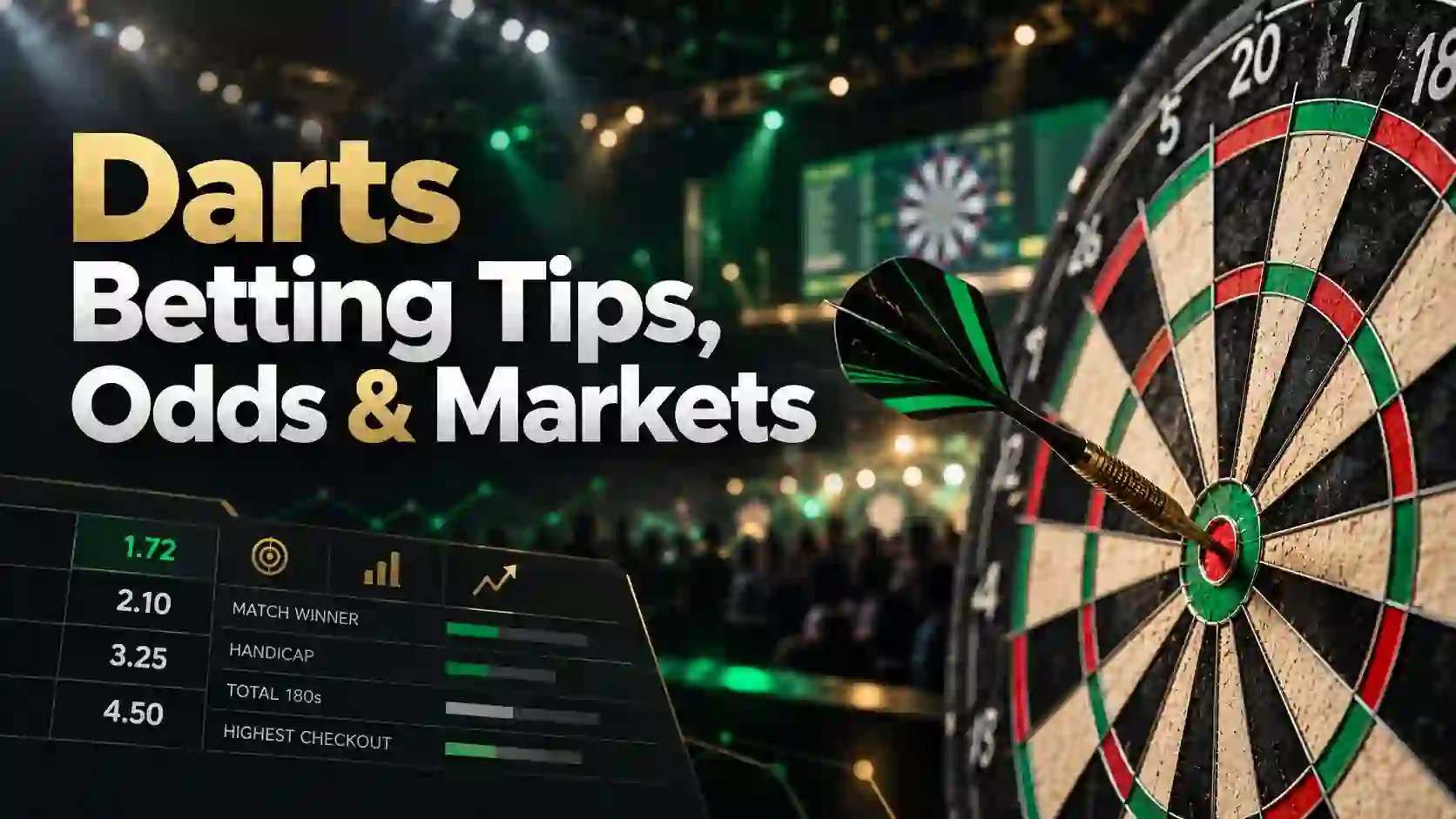
The simplest market is the match winner, where you choose which player will win. Modern sportsbooks, however, may offer dozens of additional markets covering areas such as:
- Correct match score
- Leg or set handicaps
- Total legs or sets
- Player 180s
- Total match 180s
- Most 180s
- Highest checkout
- 100+ checkouts
- First player to hit a 180
- Individual leg betting
- Nine-dart finishes
- Tournament outright winner
Representative sportsbook listings show markets including match result, leg handicap, total legs, total 180s, player 180 totals, highest checkout and correct score. Market availability varies according to the bookmaker, competition and stage of the event.
Understanding the underlying darts format is essential before analysing any of these markets.
Under the Darts Regulation Authority rules published through the PDC, standard legs begin at 501, with players attempting to reduce their score to exactly zero and complete the leg on a double. The bull counts as 50 and can be used as double 25 when finishing a leg.
Matches can then be organised into legs, sets or a combination of both, depending on the tournament.
That difference matters considerably when betting.
A best-of-11-legs match provides fewer opportunities for 180s than a long set-play contest, while a longer format can give a stronger player more time to recover from a poor start.
Understanding Darts Betting Odds
Before looking for value, bettors need to understand what the odds actually represent.
UK sportsbooks commonly display fractional odds, although decimal odds are also widely available.
For example:
Even money (1/1) means a £10 winning stake would produce £10 profit plus the original £10 stake.
2/1 means a £10 successful bet returns £20 profit plus the stake.
1/2 means a £10 successful bet produces £5 profit plus the stake.
Odds can also be converted into an implied probability.
For fractional odds of 2/1, the basic calculation is:
1 ÷ (2 + 1) = 33.3%
Decimal odds make the calculation even easier:
Implied probability = 1 ÷ decimal odds
Decimal odds of 2.00 therefore represent a 50% implied probability before accounting for the bookmaker’s margin.
The important question is not simply whether a player is likely to win.
It is whether the price available represents reasonable value relative to your assessment of the player’s chances.
A favourite can win comfortably but still have been a poor-value bet if the original price underestimated the risk. Conversely, an underdog losing does not necessarily mean the analysis was bad if the available odds materially overstated the true probability of defeat.
Main Darts Betting Markets Explained
- Match Winner
The match winner or moneyline market is the most straightforward darts bet.
You select the player you expect to win the match.
If Luke Player A faces Player B, for example, the sportsbook might price the match:
- Player A — 4/7
- Player B — 6/4
Player A is the favourite, while Player B is the underdog.
For this market, consider more than overall tournament reputation. Relevant factors include recent form, scoring level, doubles performance, previous meetings, match format and performances against opponents of a similar standard.
Short formats deserve particular attention.
A few missed doubles or one poorly timed leg can have a greater effect in a race to six legs than in a much longer match.
- Darts Handicap Betting
Handicap markets give one player a theoretical advantage or disadvantage.
Suppose a player is listed at -1.5 legs.
They must win the match by at least two legs for that handicap bet to succeed.
The opponent at +1.5 legs could lose by exactly one leg and still cover the handicap.
For example:
Player A -1.5
Player B +1.5
If Player A wins 6-4, the -1.5 handicap wins.
If Player A wins 6-5, the -1.5 handicap loses, while Player B +1.5 wins.
Handicaps can be worth investigating when the outright match price appears too short but your analysis still points towards a relatively comfortable victory.
Always check whether the market is based on legs or sets, because the settlement conditions are different.
- Correct Score Betting
Correct-score betting requires predicting the exact final score.
In a first-to-six-legs match, possible results might include:
- 6-2
- 6-3
- 6-4
- 6-5
Because the bettor must predict both the winner and exact margin, correct-score odds are normally longer than standard match-winner prices.
The market may appeal when there is a strong view about the competitiveness of a match, but the additional uncertainty should not be ignored.
Rather than selecting a score because its odds look attractive, consider how frequently each player holds throw, creates break opportunities and produces competitive legs against comparable opponents.
- Total Legs
Total-legs markets allow bettors to predict whether a match will contain more or fewer legs than a line set by the bookmaker.
For example:
Over 9.5 legs
Under 9.5 legs
In a first-to-six match, the over would require at least ten legs to be played.
This market is often more about match competitiveness than simply identifying the eventual winner.
If two players appear closely matched, the over may warrant analysis. When one player’s statistical level is substantially stronger and a one-sided match looks plausible, an under line may become relevant.
The match format should always be confirmed first.
- Most 180s
A 180 is the maximum possible score from three darts and is one of the most familiar specialist darts markets.
The most 180s market asks which player will record more maximums during the match.
This is where simply backing the match favourite can be misleading.
Some elite players win through consistently heavy scoring and strong finishing without necessarily producing the highest 180 rate. Another player may be particularly prolific on treble 20 even while having a weaker overall game.
When researching this market, look at:
- 180s per leg
- Recent maximum counts
- Typical scoring routes
- Expected number of legs
- Opponent strength
- Sample size
Raw 180 totals can be deceptive because players competing in longer matches naturally receive more opportunities.
A rate-based figure such as 180s per leg can therefore provide useful context.
- Player Total 180s
Instead of comparing two players, sportsbooks may set an over/under line for an individual’s number of 180s.
For example:
Player A over 2.5 180s
Three or more maximums would win the over.
This market combines the player’s maximum-hitting rate with expected match length. Even a prolific 180 hitter may struggle to clear a high line if the match is likely to end quickly.
A useful starting estimate is:
Expected 180s = projected legs × historical 180s per leg
That is not a complete prediction model, but it encourages more disciplined analysis than looking only at a player’s most recent match.
- Highest Checkout
The highest checkout market concerns which player records the biggest successful finish during the match.
This market has higher short-term variance than many bettors initially realise.
A player may average exceptionally well but never receive an opportunity at a large finish. Another could produce a 130+ checkout despite otherwise playing an ordinary match.
Statistics involving successful ton-plus checkouts can provide context, but opportunities matter too.
Because the outcome can depend heavily on a relatively small number of attempts, bettors should be particularly cautious about drawing conclusions from tiny samples.
- Checkout Markets
Other checkout markets can include:
- Over/under highest checkout
- Player to record a 100+ checkout
- Total 100+ checkouts
- 170 checkout
- Highest checkout and match winner
A 170 is the highest possible three-dart checkout, completed with treble 20, treble 20 and bullseye.
These specialist markets can carry attractive-looking prices, but longer odds do not automatically mean better value.
Always consider how often the event in question actually occurs.
- Nine-Dart Finish Betting
A nine-dart finish is a perfect leg of 501 darts and one of the sport’s rarest achievements.
Some bookmakers offer a market on whether a nine-darter will occur in a particular match or tournament.
The possibility creates excitement, particularly in elite events, but rarity matters. A large price should not be mistaken for an automatically attractive bet.
For analytical purposes, a bettor would need to consider scoring quality, match length, number of elite players involved and the total volume of legs expected.
Darts Betting Tips: What to Analyse Before Betting
There is no guaranteed darts betting strategy, but a structured research process can improve decision-making.
Analyse Recent Form — But Use a Meaningful Sample
Recent results matter, but simply looking at wins and losses is inadequate.
A player can win while performing below their usual standard or lose despite producing excellent darts.
Look deeper at recent performances, including:
- Three-dart average
- First-nine average where available
- Checkout percentage
- 180 frequency
- Legs won and lost
- Quality of opposition
Avoid overreacting to one exceptional or terrible match.
Darts performance naturally fluctuates. A larger sample can provide a better indication of a player’s current level.
Examine Scoring and Finishing Separately
Two players with similar averages can have very different profiles.
One may dominate through heavy scoring but regularly waste opportunities on doubles. Another may score slightly less but finish efficiently when chances appear.
That distinction is important because different markets emphasise different skills.
For 180 markets, maximum-hitting frequency matters heavily.
For match winner and handicap markets, a combination of scoring, finishing and the ability to create break opportunities becomes more relevant.
Consider the Match Format
One of the most important darts betting tips is also one of the easiest to overlook: check the format before looking at the odds.
Professional darts tournaments do not all use identical structures. Current PDC events span a variety of competitions and formats, while some events use legs and others incorporate set play.
Longer matches generally offer more scoring opportunities and more time for stronger players to recover from short periods of poor performance.
Shorter races can produce greater volatility.
Format therefore affects:
- Match winner probability
- Handicap margins
- Total legs
- 180 totals
- Checkout opportunities
- Correct scores
Never analyse the statistical numbers without first understanding how many legs or sets could actually be played.
Study 180s Per Leg, Not Only Total 180s
Suppose Player A has recorded 20 maximums across five recent matches while Player B has recorded only 16.
That does not automatically mean Player A is the stronger 180 selection.
If Player A played 70 legs and Player B played 45, Player B actually produced maximums at the higher rate.
Normalising statistics for match length gives a more useful comparison.
Consider the Strength of Opposition
Statistics should always have context.
A high average against weaker opposition is not necessarily equivalent to producing the same level repeatedly against elite players in major televised matches.
Opponent quality can affect:
- Pressure on doubles
- Number of checkout opportunities
- Length of matches
- Chances to break throw
- Rhythm and tempo
When possible, compare performances against players of a similar standard to the upcoming opponent.
Be Careful With Head-to-Head Records
Head-to-head records are popular because they are easy to understand, but they can be misleading.
A 7-2 career advantage may look important until you discover that several matches took place years earlier when both players were operating at completely different levels.
More recent meetings are usually more relevant, but even then, check the circumstances and match format.
Head-to-head statistics should be one piece of evidence rather than the entire argument.
How to Find Value in Darts Betting Odds
Good betting analysis is ultimately about the relationship between probability and price.
Imagine you estimate that a player has a 60% chance of winning.
A 60% probability corresponds approximately to decimal odds of:
1 ÷ 0.60 = 1.67
If the sportsbook offers 1.90, your estimate suggests potential theoretical value.
If it offers 1.45, your analysis suggests the price may be too short.
The difficult part, of course, is producing a reliable probability estimate.
That requires consistent methodology rather than intuition.
A basic darts model might incorporate:
- Recent scoring average
- Longer-term baseline average
- Checkout performance
- 180 rate
- Hold and break performance
- Strength of schedule
- Match format
- Recent workload
- Surface or stage context where meaningful
Do not add factors simply because they sound interesting. Each variable should have a defensible relationship to the market you are analysing.
Common Darts Betting Mistakes
One common mistake is chasing recent results.
A player hitting a 110 average yesterday does not mean they will repeat it today.
Another is backing famous players automatically. Reputation is normally reflected in the odds, so identifying the better-known player is not the same as identifying a useful price.
Bettors also frequently ignore market correlation.
For example, expecting a very short match while simultaneously backing an extremely high total number of 180s may involve assumptions that work against each other.
Another mistake is concentrating on potential returns instead of probabilities. Odds of 20/1 can look exciting, but the price is irrelevant unless the underlying event has a realistic chance of occurring often enough.
Finally, always read the bookmaker’s settlement rules.
The UK Gambling Commission requires licensed betting operators in Great Britain to make core acceptance and settlement rules available, including circumstances in which bets may be voided and how relevant contingencies are handled.
Individual sportsbook rules can differ. For example, published darts settlement rules may specify different treatment for interrupted matches, handicaps, correct scores and specialist markets.
Bankroll Management for Darts Betting
Bankroll management does not turn a losing prediction into a winning one, but it can limit the financial impact of inevitable losing runs.
A sensible approach begins by deciding in advance how much money you are comfortable allocating to betting.
From there:
Use consistent stakes. Avoid dramatically increasing stakes because you feel unusually confident.
Avoid chasing losses. A previous losing bet has no effect on whether the next selection represents value.
Separate betting money from essential finances. Never use money required for rent, bills, food, debt repayments or other necessities.
Record bets. Tracking the market, odds, stake and result provides a clearer picture of long-term performance than memory alone.
Set limits before betting. Time and deposit controls can make those limits easier to maintain.
The UK Gambling Commission advises consumers to check that operators are licensed, understand terms and conditions and make use of tools designed to control gambling time and expenditure.
Is Live Darts Betting Different?
Live or in-play darts betting adds another layer of information because part of the match has already happened.
Markets can change after virtually every leg.
Useful observations may include:
- Current scoring levels
- Frequency of double attempts
- Whether either player is creating consistent break chances
- Remaining match length
- Changes in 180 lines
- Scoreboard position
But live betting also brings a major analytical danger: overreacting to extremely small samples.
Three excellent legs do not necessarily mean a player’s underlying ability has suddenly changed.
Prices also move quickly, so avoid placing a bet simply because you fear missing an opportunity.
Which Darts Betting Market Is Best?
There is no universally best darts betting market.
The most appropriate market depends on what your analysis actually identifies.
If your strongest evidence concerns overall player quality, the match winner may be the clearest market.
If you expect a favourite to dominate, a leg handicap could be relevant.
If two players appear evenly matched, total legs may deserve analysis.
If one player consistently produces maximums at a high rate, the 180 markets may fit the statistical evidence better than the match result.
The key principle is simple:
Choose the market that matches your analytical edge rather than forcing every opinion into a match-winner bet.
FAQs
What does -1.5 mean in darts betting?
A -1.5 leg handicap means the selected player must win by at least two legs for the bet to succeed. Always confirm whether the bookmaker’s handicap applies to legs or sets.
What does over 5.5 180s mean?
It means the relevant player or match must produce at least six 180s for an over 5.5 bet to win.
What is a checkout in darts?
A checkout is the combination used to reduce a player’s remaining score to exactly zero and win the leg. Under standard PDC/DRA rules, the finishing dart must land in a double, with the bull capable of counting as double 25.
What is the highest possible checkout in darts?
The highest possible three-dart checkout is 170, normally completed by hitting treble 20, treble 20 and bullseye.
Is betting on 180s better than betting on match winners?
Neither market is inherently better. They measure different aspects of performance. Match-winner analysis considers overall ability to win the contest, while 180 betting places much greater emphasis on maximum-scoring frequency and expected match length.
Can darts betting tips guarantee a profit?
No. Darts contains uncertainty, and bookmaker prices incorporate a margin. Even well-researched bets can lose. Any source claiming guaranteed betting profits should be treated cautiously.
What statistics are most useful for darts betting?
Useful statistics can include three-dart averages, checkout percentages, 180s per leg, hold and break rates, recent results and performance against comparable opposition. Which statistics matter most depends on the betting market being analysed.
Final Thoughts
Darts offers one of the broadest ranges of betting markets in professional sport, from straightforward match winners to highly specific 180 and checkout markets.
The number of options does not mean every market represents an opportunity.
A more disciplined approach starts with understanding the match format, examining relevant statistics and then comparing your estimated probability with the available odds.
Focus on evidence rather than player reputation. Separate scoring ability from finishing performance. Account for match length when analysing 180s. Treat head-to-head data carefully, and always understand how the bookmaker will settle the market before staking money.
Most importantly, remember that betting should never be viewed as a guaranteed way to make money.
The strongest darts betting approach is not one that promises winners. It is one built around careful research, price awareness, disciplined staking and responsible decision-making.
Responsible Gambling: Gambling involves risk and should only be undertaken by adults where it is legal to do so. Never bet more than you can afford to lose. In Great Britain, the Gambling Commission recommends using licensed operators and provides information on spending controls, account history, payment blocks and self-exclusion.
ADVERTISEMENT

18+ | Affiliate link | Terms apply | Please gamble responsibly.


