

18+ | Affiliate link | Terms apply | Please gamble responsibly.
Last Updated on October 2, 2026 by Maurya
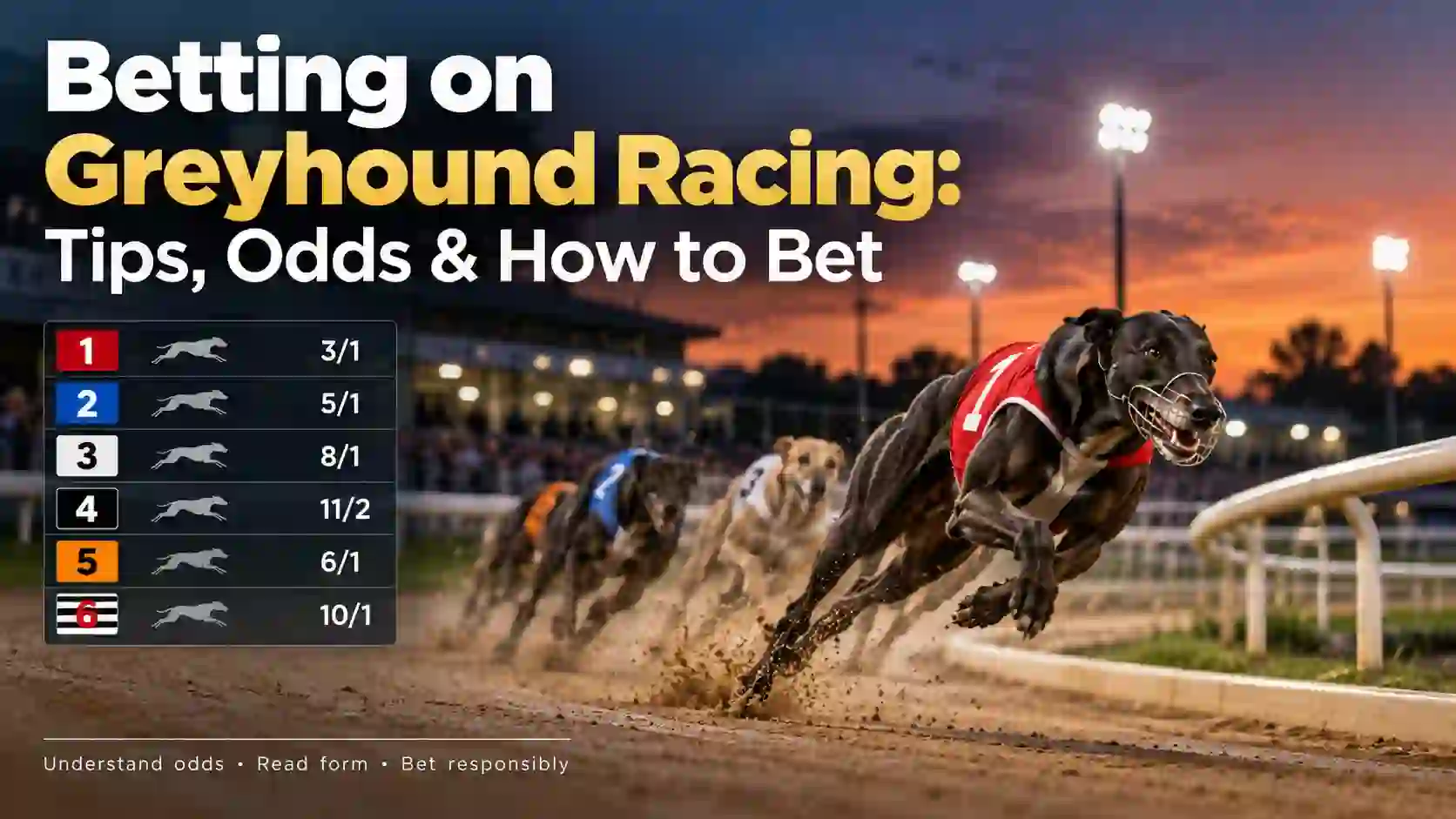
Betting on greyhound racing can look deceptively simple. Six runners line up in their traps, the boxes open, and within less than a minute the race may be over. Yet behind that short burst of action are several factors that experienced race readers consider before placing a bet: early speed, trap position, running style, recent form, race distance, grade and the price being offered.
Understanding those factors is more useful than searching for a supposedly unbeatable greyhound betting system. No strategy can remove uncertainty from racing, and even a strong favourite can be beaten by a slow start, crowding at the first bend or simply a better performance from another runner.
What Is Greyhound Racing Betting?
Greyhound racing betting involves wagering on the result of a race or on specific finishing combinations.
The simplest bet is predicting which greyhound will win. However, bookmakers and betting pools may also offer markets involving the first two or three finishers, individual trap numbers or results across an entire meeting.
Greyhound races are generally short compared with many horse races. In Great Britain, current Greyhound Board of Great Britain rules define a race as a simultaneous contest involving up to eight greyhounds over distances from 200 metres to 1,105 metres, although field sizes and typical distances vary by track and jurisdiction.
Because the action unfolds quickly, positioning in the first part of a race can be particularly significant. A runner capable of reaching the opening bend cleanly may have an advantage, while a greyhound that encounters traffic can lose valuable momentum.
That is why effective race analysis involves much more than choosing the dog with the most appealing name or automatically backing the favourite.
How to Bet on Greyhound Racing
If you are new to greyhound betting, the basic process is relatively straightforward.
- Choose a Race
Start by selecting a race at a licensed track.
The racecard normally displays information such as:
- Greyhound names
- Trap numbers
- Recent finishing positions
- Race grade
- Distance
- Previous race times
- Trainer
- Comments on previous runs
- Current or forecast odds
Take a few minutes to understand the race before considering any wager.
- Study the Runners
Look beyond each greyhound’s most recent finishing position.
A dog that finished fourth after encountering significant interference may have produced a stronger performance than the bare result suggests. Conversely, a recent winner that enjoyed an uncontested run may face a more difficult setup today.
Useful information can include recent times, sectional or split times, trap history, distance performance and how the runner typically approaches the first bend.
- Compare the Odds
Next, compare your assessment of each greyhound with the available betting odds.
This is a critical distinction.
Finding the greyhound you think is most likely to win is not necessarily the same as finding the best betting value.
If you believe a runner has approximately a 25% chance of winning but the available price implies only a 20% chance, the price may appear attractive according to your assessment.
Your estimate could still be wrong. The purpose of studying odds is not to guarantee a return but to consider whether the potential reward reasonably reflects the risk.
- Choose Your Bet Type
Decide whether you want a simple win bet or something more complex such as a forecast.
Beginners are generally better served by understanding straightforward markets before experimenting with combination bets.
- Decide Your Stake
Set the amount before placing the wager.
Avoid increasing the stake simply because you lost on the previous race. Chasing losses can turn a planned entertainment expense into uncontrolled gambling; GamCare identifies chasing losses as a warning sign of gambling harm.
Understanding Greyhound Racing Odds
Odds perform two jobs.
First, they show the potential return on a successful bet.
Second, they indicate the probability implied by the market price.
Decimal Odds
Decimal odds are easy to calculate.
Suppose a greyhound is offered at 4.00 and you stake £10.
Your total return would be:
£10 × 4.00 = £40
That £40 includes your original £10 stake, meaning the profit is £30.
Fractional Odds
Fractional prices are traditionally common in Britain and Ireland.
At 3/1, a £10 winning stake produces £30 profit, with the £10 stake also returned.
Total return:
£40
Another example:
At 5/2, a £10 stake produces £25 profit plus the original £10 stake, giving a total return of £35.
Converting Odds Into Implied Probability
Odds can also be converted into an implied probability.
For decimal odds, the basic calculation is:
Implied probability = 1 ÷ decimal odds × 100
Examples:
- 2.00 = 50%
- 3.00 = 33.3%
- 4.00 = 25%
- 5.00 = 20%
A greyhound trading at decimal odds of 4.00 therefore has an implied probability of approximately 25% before considering bookmaker margin and other market effects.
Thinking in probabilities rather than simply asking whether an odds number “looks big” is one of the more useful habits a bettor can develop.
Common Types of Greyhound Racing Bets
Different operators and jurisdictions may offer different markets, but several bet types appear regularly.
Win Bet
A win bet is the simplest option.
You select one greyhound to finish first.
For example:
Trap 3 — £10 win at 4.00
If Trap 3 wins, the total return is £40.
If it does not win, the stake is lost.
For beginners learning how to read races, win bets are easier to evaluate than complicated combinations.
Place Betting
Some operators or pool systems may offer place-related markets, although the conditions can differ considerably depending on field size and operator rules.
Always check exactly what counts as a winning place before confirming the bet.
Never assume that place terms from horse racing automatically apply to greyhound racing.
Straight Forecast
A straight forecast requires you to predict the first two finishers in their exact order.
For example:
- Trap 2 to finish first
- Trap 5 to finish second
Both selections must finish in that precise order for the forecast to succeed.
Reverse Forecast
A reverse forecast covers two possible finishing orders.
For example, selecting Traps 2 and 5 could cover:
- 2 first, 5 second
- 5 first, 2 second
Because more than one combination is covered, the total stake calculation differs from a straight forecast.
Forecast settlement rules can also vary between fixed-odds and pool-style bets, so checking an operator’s betting rules before wagering is important. Betfair’s published greyhound rules, for example, distinguish between Tote/industry forecast settlement and fixed-odds forecast markets.
Tricast
A tricast requires predicting the first three finishers.
A straight tricast requires the exact finishing order.
For example:
- Trap 4
- Trap 1
- Trap 6
The increased number of possible combinations makes tricasts substantially more difficult to land than a straightforward win bet.
Combination versions can cover several orders, but costs can rise quickly as more permutations are included.
Trap-Based Markets
Some bookmakers provide additional markets based on trap numbers rather than an individual greyhound.
One example is a Trap Challenge, where the objective may be to identify which trap produces the highest number of winners over a meeting. Rules differ between providers; Betfair, for example, states that its Trap Challenge is based on the trap recording the most winners during the relevant meeting unless the market information says otherwise.
Always read the exact market rules rather than assuming all bookmakers settle specialty bets identically.
How Greyhound Traps Work
Understanding trap positions is central to greyhound race analysis.
Trap numbers normally move from the inside rail outward. Under current GBGB rules, Trap 1 starts nearest the inside rail, with subsequent trap numbers positioned outward across the track.
However, thinking that Trap 1 is automatically “best” is a mistake.
Different greyhounds have different running preferences.
In British racing, runners can be classified according to where they prefer to race. Current GBGB processes distinguish between:
- Railers — generally suited toward the inside
- Middle runners — prefer central positions
- Wide runners — prefer outside positions
GBGB’s current trap-allocation rules take those classifications into account rather than treating every dog as equally suited to every trap.
For the bettor, the more useful question is therefore not:
“Which trap wins most often?”
It is:
“How well does this particular trap position suit this greyhound and the runners around it?”
8 Greyhound Racing Betting Tips
No betting tip can guarantee a profit. These principles are better viewed as a structured way to analyse a race.
- Focus on Early Pace
Greyhound races can be decided very quickly.
A fast break may allow a runner to reach the first bend without interference. A greyhound with strong overall speed but a consistently slow start may face a greater risk of encountering traffic.
When available, examine sectional or split times rather than relying solely on final race times.
They can provide useful clues about early acceleration.
- Study the First Bend
The first bend is often one of the most important parts of a greyhound race.
Ask how the runners are likely to approach it.
Will an inside runner move outward?
Will a wide runner cut toward the middle?
Could two neighbouring greyhounds compete for the same racing line?
Potential crowding does not mean interference will definitely happen, but anticipating how running styles interact can provide a more complete picture than evaluating each dog independently.
- Examine Trap Suitability
A good trap draw should complement the greyhound’s natural racing style.
A runner that repeatedly performs well from similar positions deserves attention.
However, avoid treating historical trap statistics as an automatic system. The individual runners, race grade, distance and neighbouring dogs matter as well.
- Compare Recent Times Carefully
Raw finishing positions can be misleading.
Consider two greyhounds:
Greyhound A: won its previous race in 29.80 seconds.
Greyhound B: finished third in 29.55 seconds.
If today’s conditions are sufficiently comparable, the third-place runner may still have produced the stronger time.
But times should not be compared blindly across different tracks, distances or track conditions.
Context matters.
- Understand Race Grades
Not every victory represents the same level of performance.
In British racing, GBGB distinguishes several categories, including graded races and open races. A graded race is assembled by a Racing Manager from eligible runners, while open races are advertised events that may draw entries from eligible trainers under the race conditions.
A greyhound dropping into an easier assignment may merit closer attention, while one moving into stronger competition may need to improve.
Look at the quality of opposition, not simply the sequence of previous finishing positions.
- Consider the Distance
Some greyhounds are suited to sharp sprint races, while others perform better when stamina becomes more important.
Ask whether today’s distance matches the runner’s demonstrated strengths.
A greyhound that frequently leads before weakening late may benefit from a shorter distance. Conversely, a strong finisher may appreciate additional metres, provided it does not lose too much ground early.
Current GBGB rules recognise different distance categories and qualification requirements, reinforcing the fact that performance characteristics can vary significantly by trip.
- Watch Race Replays Where Available
Numbers tell only part of the story.
Video can help reveal:
- Missed breaks
- Crowding
- Bumping
- Wide running
- Strong late finishes
- Clear-race advantages
- Difficulty finding racing room
A fourth-place finish might look poor on paper but considerably better after watching the runner lose momentum through interference.
Likewise, an impressive victory may look less compelling if the winner enjoyed an unusually clear passage while its main rivals encountered trouble.
- Demand a Sensible Price
Perhaps the most important greyhound betting principle is remembering that selection and price are separate decisions.
You might correctly identify the most likely winner but still decide the odds are too short for the uncertainty involved.
Imagine you estimate that a greyhound should win roughly once in every three comparable situations, or around 33% of the time.
Odds of 2.00 imply roughly a 50% probability.
Odds of 4.00 imply roughly 25%.
Neither price guarantees anything. But comparing your own probability assessment with the market helps turn “I like this dog” into a more disciplined decision about whether the available odds justify the risk.
How to Read a Greyhound Racecard
Racecards vary between providers, but several pieces of information are especially useful.
Trap Number
Shows the runner’s starting position.
Analyse it alongside the greyhound’s preferred racing line and neighbouring runners.
Recent Form
Recent finishing positions provide a quick summary but should be treated as a starting point rather than the entire analysis.
Look deeper into how those results occurred.
Race Time
Recent times can indicate speed, particularly when races took place under comparable conditions.
Split or Sectional Time
Where published, the split time measures an early portion of the race and can be particularly useful for identifying quick starters.
Grade
The grade helps establish the standard of competition.
A move between grades can significantly change the difficulty of a race.
Distance
Check whether the greyhound has demonstrated good form over the same or a comparable distance.
Comments
Race comments can highlight events not obvious from the finishing position, including slow starts, crowding, checking or strong finishes.
Favourite vs Outsider: Which Should You Bet?
Neither favourites nor outsiders are automatically better bets.
A favourite is simply the runner currently given the shortest price by the market. It may have the strongest form, but the market may already reflect that advantage.
Similarly, a 10/1 outsider is not automatically good value simply because the potential return is larger.
Consider price and probability together.
Suppose Greyhound A has a 50% estimated chance of winning and Greyhound B has a 15% chance.
A bettor should not choose B merely because its odds look more exciting. The question is whether the odds compensate for its lower estimated probability.
This principle applies across virtually every betting market:
High odds do not automatically mean value, and short odds do not automatically mean poor value.
Common Greyhound Betting Mistakes
Understanding what to avoid can be as important as knowing what to analyse.
Betting Every Race
There is no requirement to have a bet simply because a race is available.
Skipping races where you cannot form a clear view can be part of disciplined decision-making.
Following Trap Statistics Blindly
Historical trap results may provide useful context, but they do not tell you how today’s individual runners will perform.
Ignoring Price
Predicting winners and making good betting decisions are not identical.
Always consider whether the odds reflect the uncertainty involved.
Increasing Stakes After a Loss
Previous losses do not make the next bet more likely to win.
Each betting decision should stand on its own.
Using Money Needed for Essentials
Gambling should never compete with rent, food, utilities, debt payments or other financial responsibilities.
Believing in Guaranteed Systems
No legitimate method can guarantee consistent winning outcomes in greyhound racing.
Unexpected breaks, interference, performance variation and market uncertainty are inherent parts of racing.
Bankroll Management and Safer Greyhound Betting
Bankroll management does not transform gambling into a risk-free activity. Its purpose is to establish limits before emotions influence decisions.
A safer approach includes deciding in advance:
- The maximum amount you can afford to lose
- How much you will stake on an individual race
- How long you intend to gamble
- When you will stop
The UK Gambling Commission advises consumers to use tools that control the time and money spent gambling and provides information on spending controls, self-exclusion and gambling-payment blocks.
GamCare similarly advises setting money and time limits and warns against borrowing to gamble or attempting to win back previous losses.
If gambling stops feeling like entertainment or begins affecting finances, work, relationships or wellbeing, stopping and seeking support is more important than finding another betting strategy.
For people in Great Britain, GamCare’s National Gambling Helpline provides free and confidential support on 0808 8020 133.
FAQs
How do you bet on greyhound racing?
Choose a race, study the runners and racecard, compare the available odds, select a betting market and decide your stake before placing the wager. A standard win bet simply requires your chosen greyhound to finish first.
What is the easiest greyhound bet for beginners?
A win bet is generally the easiest to understand because only one outcome matters: your selected greyhound must win. Forecasts and tricasts require correctly predicting multiple finishing positions and therefore involve more combinations.
What does a trap number mean in greyhound racing?
The trap number identifies the starting box assigned to a greyhound. Trap 1 is normally nearest the inside rail, with the numbers increasing outward. Trap suitability depends on the greyhound’s racing style rather than there being one universally superior position.
What is a forecast bet in greyhound racing?
A forecast involves predicting the first two finishers. A straight forecast requires them in the exact order, while a reverse forecast covers either ordering of the two selected runners.
What is a tricast?
A tricast involves predicting the first three finishers. A straight tricast requires the exact finishing order. Combination variants may cover multiple orders but require additional stakes.
Are favourites always the safest greyhound bets?
No. A favourite is the shortest-priced runner in the market, not a guaranteed winner. Its odds reflect the market’s assessment and other pricing factors, and favourites can lose like any other runner.
Which trap is best in greyhound racing?
There is no universally best trap. The suitability of the draw depends on the track, the individual greyhound’s racing style and the runners positioned around it.
Can you make guaranteed money betting on greyhounds?
No. Greyhound racing contains unavoidable uncertainty, and no betting strategy can guarantee profits. Claims of guaranteed winning systems should be treated with considerable scepticism.
What should I look for when choosing a greyhound?
Useful factors include early pace, sectional times, recent race times, trap suitability, running style, race grade, distance record, quality of previous opposition and what happened during recent races.
Is greyhound betting based only on luck?
Race outcomes contain uncertainty, but bettors can analyse measurable factors such as form, pace, times, grade and trap position. Analysis cannot eliminate risk or guarantee that the expected outcome will occur.
Final Thoughts
Successful race analysis begins with understanding what you are actually betting on.
Instead of choosing runners solely on recent finishing positions or automatically backing favourites, examine the complete race. Consider how quickly each greyhound starts, where it wants to run, whether neighbouring dogs could create congestion, how today’s distance suits it and whether its recent performances are competitive at the current grade.
Then consider the odds.
A strong opinion about the likely winner is only one part of a betting decision. The price determines how much potential reward you receive for accepting the risk that your assessment may be wrong.
Most importantly, keep expectations realistic.
Greyhound racing is unpredictable. A carefully analysed selection can lose, and a runner you dismissed can produce a career-best performance. There is no betting system capable of eliminating that uncertainty.
Treat betting as paid entertainment rather than a source of income, set financial limits before you start and never chase money that has already been lost.
The most useful greyhound racing betting strategy is therefore not a secret formula. It is a disciplined process: understand the race, analyse the runners, understand the odds, question the price and only bet within predetermined limits.
ADVERTISEMENT

18+ | Affiliate link | Terms apply | Please gamble responsibly.


