Last Updated on June 29, 2026 by Maurya
Gambling has never been easier to access. What once required a trip to a casino now lives in your pocket: sports betting apps, online slots, daily fantasy, lottery scratch cards at the corner store, and poker rooms a tap away. With access this frictionless, a single decision matters more than ever — the decision you make before you gamble.
What “Gambling” Really Means
At its core, gambling is staking something of value on an uncertain outcome in the hope of winning something greater. That simple definition covers a huge range of activities: casino table games, slot machines, sports and esports betting, online casinos, lotteries, scratch cards, bingo, poker, and even some video game “loot boxes” that mimic the mechanics of a wager.
The scale of the industry is enormous. The global gambling market — measured by the total amount players lose to operators — was estimated to approach $531 billion in 2025, according to research published in The Lancet Public Health. In the United States alone, the majority of states (around 38) have legalized sports betting since 2018, fueling explosive growth in mobile wagering. Convenience is the headline story of modern gambling, and convenience changes behavior. The easier something is to do, the more often we do it.
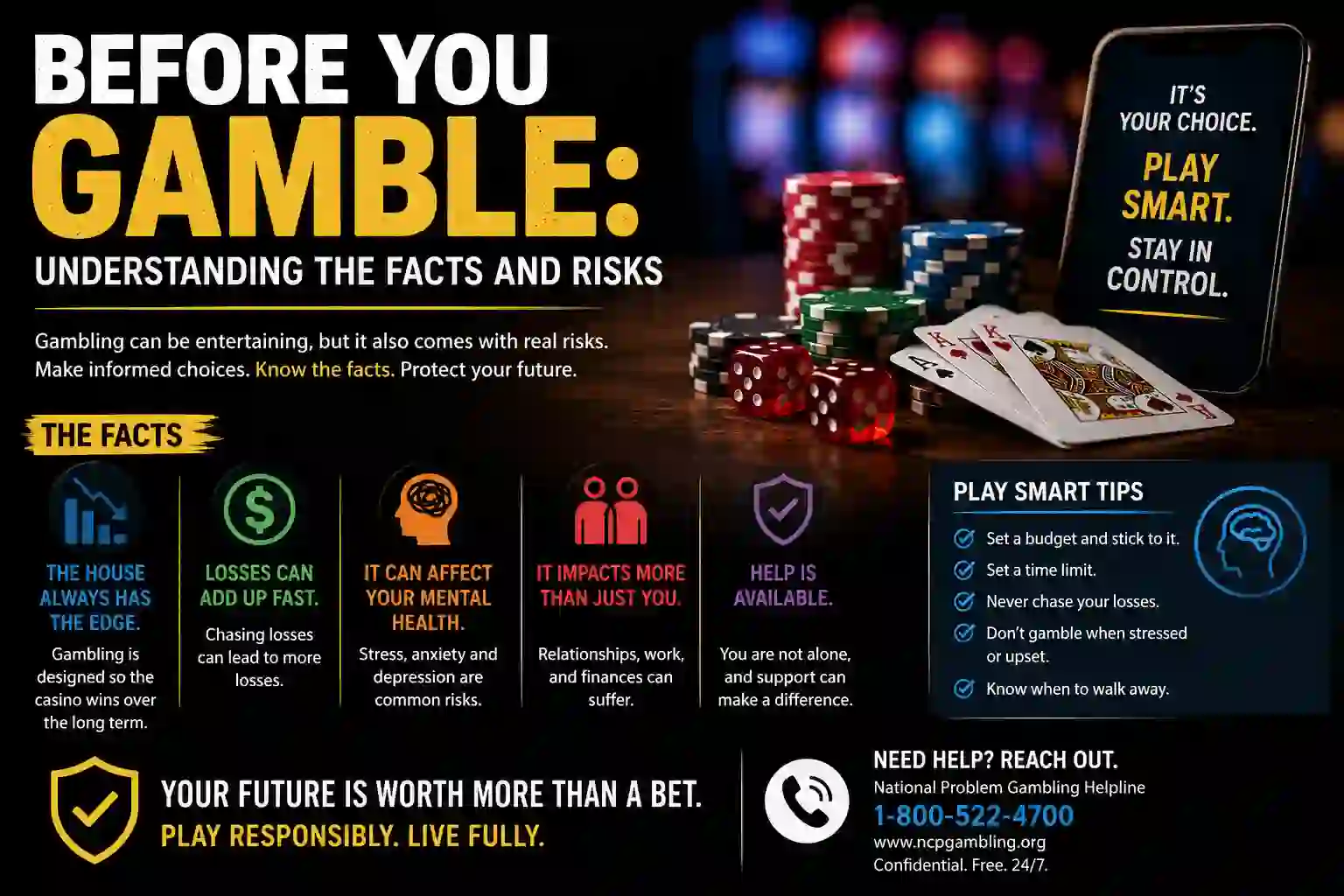
The House Always Has an Edge
Here is the single most important fact about commercial gambling, and the one operators are happiest for you to overlook: the games are mathematically designed so that the operator profits over time. This built-in advantage is called the house edge, and it is not an accident, a streak, or bad luck. It is the entire business model.
Consider roulette. On an American double-zero wheel, the house edge is about 5.26% — meaning that, on average, the casino keeps roughly five cents of every dollar wagered over the long run. On a European single-zero wheel it’s about 2.70%. Slot machines, the most profitable games on most casino floors, typically carry a house edge anywhere from 2% to 15% depending on the machine. Every legitimate game of chance carries a negative expected value for the player: play it long enough and the math grinds against you.
This connects to a principle from statistics called the law of large numbers. In the short term, anything can happen — you can absolutely win, sometimes big, and that’s what keeps gambling exciting. But the more you play, the closer your results converge toward that built-in negative expectation. Time at the table is not your friend. The longer you play, the more reliably the house edge asserts itself.
It’s also worth dismantling a common myth: in games of pure chance, past results have no effect on future ones. A roulette wheel that has landed on red eight times in a row is no more “due” for black on the next spin. Slot machines use random number generators that make each spin completely independent. The belief that outcomes are owed or trending — the gambler’s fallacy — has emptied countless wallets.
Why Our Brains Get Hooked
If the math is so clearly stacked against us, why is gambling so compelling? The answer lies in how the games are engineered to exploit the brain’s reward system.
The key mechanism is something psychologists call a variable-ratio reinforcement schedule — rewards that arrive unpredictably, after a varying number of attempts. Decades of behavioral research have shown this is the most powerful pattern for driving repeated behavior, more compelling than a predictable reward. It’s the same principle that makes slot machines and loot boxes so hard to put down: you never know if the next spin is the one, so you keep spinning. Each potential win releases dopamine, the brain’s anticipation-and-reward chemical, and crucially, the anticipation itself produces the rush — not just the payout.
Modern machines layer on additional psychological hooks:
- Near misses: Symbols that land just short of a jackpot are engineered to occur more often than chance, and the brain reads them almost like wins, fueling another attempt.
- Losses disguised as wins: On multi-line slots, you can bet on twenty lines, “win” on two, lose money overall, and still be greeted with celebratory lights and sounds — masking a net loss as a victory.
- The illusion of control: Letting players roll the dice, pick numbers, or press the button creates a false sense that skill influences a random outcome.
Because these mechanisms act on the brain’s reward circuitry much like addictive substances do, the American Psychiatric Association formally reclassified gambling disorder as a behavioral addiction in the DSM-5, placing it alongside substance-use disorders. This was a landmark recognition: for some people, gambling is not a failure of willpower but a genuine, diagnosable condition.
The Real Risks: Financial, Mental, and Social
The most visible risk of gambling is financial, but it’s rarely the most damaging one. Debt, drained savings, borrowed money, and missed bills are common, and they can spiral quickly when someone starts chasing losses — betting more in a desperate attempt to win back what they’ve lost, which usually deepens the hole.
The psychological toll can be more severe than the financial one. Problem gambling is strongly associated with anxiety, depression, insomnia, and substance use. Most seriously, the research on suicide is sobering: the American Psychiatric Association notes that gambling disorder carries one of the highest suicide risks of any addictive disorder, with studies finding that a large share of people with the disorder experience suicidal thoughts and a meaningful proportion attempt suicide. These outcomes are tied to the crushing sense that a financial situation is hopeless — when, in reality, help and recovery are available.
The damage radiates outward, too. Relationships fracture under the weight of secrecy, broken promises, and financial stress. Research consistently finds that for every person experiencing gambling harm, several others in their orbit — partners, children, parents, friends — are affected. Work and study suffer as preoccupation crowds out focus. Gambling harm is rarely a solo event.
How Common Are Gambling Problems?
More common than most people realize — and rising fastest among young people and online bettors.
According to a 2024 national survey conducted by the National Council on Problem Gambling (NCPG), roughly 8% of U.S. adults — about 20 million people — reported experiencing at least one indicator of problematic gambling behavior multiple times in the past year. The risk is not evenly distributed:
- Young adults are most exposed. Around 15% of adults aged 18–34 reported concerning gambling behavior, compared with just 2% of those 55 and older.
- Men face higher risk. About 10% of men reported gambling-related problems — roughly double the rate for women, with some research suggesting men are up to three times more likely to gamble at a problematic level.
- Online play tracks closely with harm. Online gambling participation rose from 15% in 2018 to 22% in 2024, and online formats are consistently linked to higher rates of problems. Riskier bet types are climbing too: the share of sports bettors placing parlay wagers — which encourage loss-chasing — nearly doubled over the same period.
Perhaps the most telling statistic is one about awareness: only about 39% of Americans view gambling addiction as “very serious,” compared with 62% for drug addiction and 55% for alcoholism. The harm is widespread, but public recognition of it lags far behind — which is exactly why understanding the facts before you gamble matters so much.
Warning Signs of Problem Gambling
Gambling problems develop gradually, and the line between entertainment and harm is easy to cross without noticing. Watch for these signs in yourself or someone you care about:
- Preoccupation — constantly thinking about past bets, planning the next one, or finding money to gamble.
- Needing to bet more to feel the same excitement (a tolerance effect).
- Chasing losses — returning another day to win back money you’ve lost.
- Restlessness or irritability when trying to cut back or stop.
- Lying to family, friends, or others to hide the extent of your gambling.
- Borrowing money, selling possessions, or neglecting bills to fund gambling.
- Gambling to escape stress, anxiety, loneliness, or low mood.
- Jeopardizing a relationship, job, or opportunity because of gambling.
If several of these resonate, it’s a strong signal to pause and reach out for support. None of them mean you’re a bad or weak person — they’re recognized symptoms of a treatable condition.
Responsible Gambling
If you choose to gamble, the goal is simple: keep it a form of paid entertainment, never an income strategy. These practical guardrails — used by treatment professionals and responsible-gambling programs worldwide — make that far more likely.
- Set a budget you can afford to lose, and treat it as the cost of entertainment — like a movie ticket or a concert. When it’s gone, you’re done.
- Decide your limits in advance, both money and time, and set them before you start, when your judgment is clearest. Many apps and casinos offer deposit limits, loss limits, and reality-check reminders — use them.
- Never gamble with money meant for essentials — rent, food, bills — or with borrowed money. Money you can’t afford to lose should never be in play.
- Don’t chase losses. Accept that losing is the expected outcome and walking away is winning.
- Don’t gamble while stressed, depressed, lonely, or under the influence. These states erode the judgment you need most.
- Take regular breaks and keep gambling a small part of a balanced life full of other activities.
- Understand the odds of whatever you’re playing, and remember the house edge never sleeps.
- Be honest with yourself. If it stops being fun, or you start hiding it, that’s your cue to stop.
A useful rule of thumb: if you’re gambling to make money or to escape something, rather than purely for entertainment, the activity has already shifted into risky territory.
Where to Get Help
If gambling is causing you or someone you love distress, support is free, confidential, and available right now. Reaching out is a sign of strength, not failure.
- National Problem Gambling Helpline (U.S.): Call or text 1-800-GAMBLER, available 24/7, free and confidential, with call, text, and chat options that connect you to local resources.
- Gamblers Anonymous: A free, peer-support fellowship with matches in person and online; Gam-Anon offers parallel support for affected family and friends.
- Self-assessment tools: The National Council on Problem Gambling offers a confidential gambling-behavior self-assessment on its website to help you gauge where you stand.
- In a crisis: If you’re having thoughts of suicide or self-harm, call or text 988 (the Suicide & Crisis Lifeline in the U.S.) immediately. A financial situation can feel permanent in a way it genuinely isn’t, and help is available 24/7.
Resources vary by country, so if you’re outside the U.S., search for your national gambling helpline or health service — most have free, confidential support lines.
FAQs
Is gambling always addictive? No. Most people who gamble do so occasionally without developing a problem. But the games are specifically engineered to encourage repeat play, and a meaningful minority of people develop gambling disorder — a recognized behavioral addiction. Risk rises with frequency, online access, and underlying stress or mental-health conditions.
Can you beat the house in the long run? For games of pure chance — slots, roulette, lotteries — no. The house edge guarantees the operator profits over time. A small number of skill-based pursuits (like professional poker, where you play against other players, or advantage play) can theoretically be beaten by a tiny, highly disciplined minority, but for virtually everyone, gambling is a net cost.
Is online gambling riskier than in-person? The data suggests it can be. Online and mobile gambling are available 24/7, are highly immersive, and remove the natural friction and pauses of a physical venue — all factors associated with higher rates of problem gambling.
How much gambling is “too much”? There’s no universal number. A better test is your relationship with it: Are you spending more than you can afford? Chasing losses? Hiding it? Gambling to cope with emotions? If yes, it’s too much regardless of the dollar figure.
Are some forms of gambling safer than others? Lower-stakes, slower games where you set strict limits carry less risk than fast, high-frequency formats like electronic gaming machines and live in-play betting, which are most strongly linked to harm. But “lower risk” is not “no risk” — the safeguards in this guide apply to all of them.
The Bottom Line
Gambling can be a legitimate form of entertainment, but it is entertainment with an unusually sharp edge. The games are mathematically built for the operator to win over time, and they’re psychologically engineered to keep you playing. Knowing this doesn’t have to spoil the fun — it’s exactly what lets you keep it fun.
Before you gamble, set a budget you can afford to lose, decide your limits in advance, never chase losses, and watch honestly for the warning signs. Treat any bet as money spent on entertainment, not money invested for return. And if gambling ever stops feeling like a choice, remember that recognizing it is the hardest part, that you’re far from alone, and that effective, confidential help is only a call or text away.


