

18+ | Affiliate link | Terms apply | Please gamble responsibly.
Last Updated on October 13, 2026 by Maurya
The sports betting industry has become increasingly technology-driven, with operators relying on sophisticated platforms to manage everything from live odds and player accounts to regulatory compliance and risk management. In 2026, choosing the right sportsbook software provider is no longer simply about launching a betting website. It is about building a secure, scalable, competitive business that can adapt to changing markets.
For new operators, the right software can simplify the technical complexities of entering a regulated sports betting market. For established bookmakers, advanced sportsbook technology can improve operational efficiency, provide greater control over trading, and support expansion into additional jurisdictions.
However, with dozens of providers offering different combinations of turnkey platforms, managed trading, odds feeds, APIs, and white label solutions, identifying the right technology partner can be challenging.
This guide explores the 10 best sportsbook software providers in 2026, examining their core products, notable strengths, potential limitations, and suitability for different types of betting operators.
Whether you are evaluating a complete sportsbook platform or looking to upgrade an existing betting operation, this comparison will help you build a more informed shortlist.
What Is Sportsbook Software?
Sportsbook software is the technology that enables licensed betting operators to accept, manage, process, and settle wagers on sporting events.
A modern sports betting platform typically combines several connected systems, including an odds management engine, betting interface, player account management tools, payment integrations, and a trading and risk management system.
The most advanced solutions also support real-time analytics, live betting, multi-language interfaces, automated bet settlement, fraud prevention, and responsible gambling controls.
Sportsbook software generally comes in three main forms:
- Turnkey sportsbook software: A comprehensive solution combining the betting platform with essential operational tools and supporting integrations.
- White label sportsbook software: A preconfigured, brandable solution that may include additional operational services, depending on the supplier and jurisdiction.
- API-based sportsbook solutions: Modular technology that operators integrate into existing websites, mobile applications, or player management platforms.
Each approach offers a different balance of customisation, operational responsibility, deployment complexity, and long-term control.
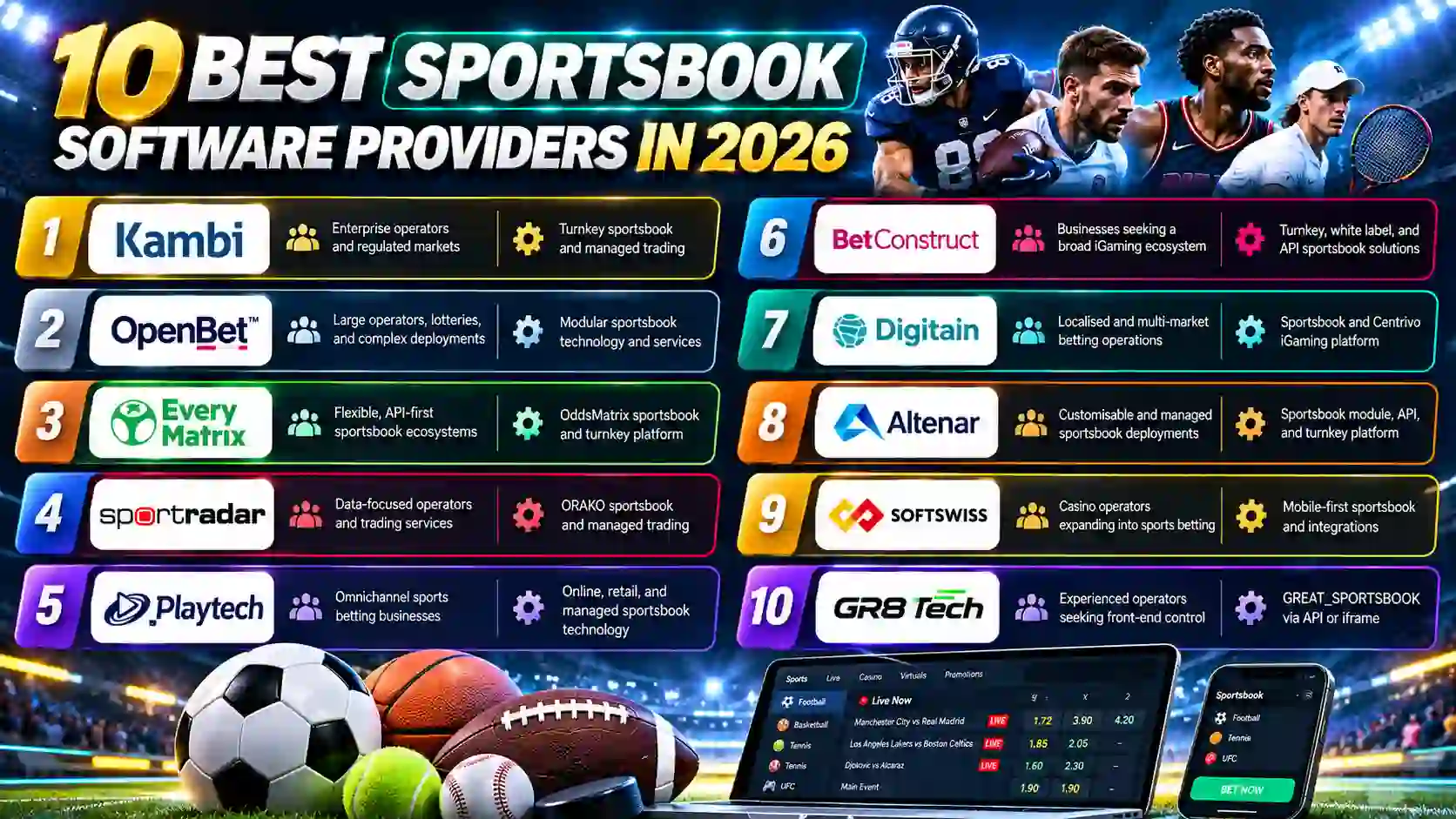
Top 10 Sportsbook Software Providers in 2026
| Provider | Best For | Main Offering |
| Kambi | Enterprise operators and regulated markets | Turnkey sportsbook and managed trading |
| OpenBet | Large operators, lotteries, and complex deployments | Modular sportsbook technology and services |
| EveryMatrix | Flexible, API-first sportsbook ecosystems | OddsMatrix sportsbook and turnkey platform |
| Sportradar | Data-focused operators and trading services | ORAKO sportsbook and managed trading |
| Playtech | Omnichannel sports betting businesses | Online, retail, and managed sportsbook technology |
| BetConstruct | Businesses seeking a broad iGaming ecosystem | Turnkey, white label, and API sportsbook solutions |
| Digitain | Localised and multi-market betting operations | Sportsbook and Centrivo iGaming platform |
| Altenar | Customisable and managed sportsbook deployments | Sportsbook module, API, and turnkey platform |
| SOFTSWISS | Casino operators expanding into sports betting | Mobile-first sportsbook and integrations |
| GR8 Tech | Experienced operators seeking front-end control | GREAT_SPORTSBOOK via API or iframe |
- Kambi — Best for Enterprise-Level Sportsbook Solutions
Website: kambi.com
Kambi is one of the most established sportsbook technology companies serving regulated betting operators. The company provides a comprehensive sports betting ecosystem designed to support online, retail, and on-property sportsbook operations.
Its flagship Turnkey Sportsbook combines betting technology, odds compilation, trading expertise, risk management, and front-end capabilities.
One of Kambi’s important advantages is its extensive operational experience across regulated jurisdictions. Its technology is designed for businesses that need established trading processes, strong platform infrastructure, and the ability to manage significant betting volumes.
Kambi also offers Odds Feed+, allowing operators to integrate pre-match and live betting odds without necessarily adopting the company’s entire sportsbook platform.
Key Features
- Fully integrated turnkey sportsbook solution.
- Advanced pre-match and live betting markets.
- Managed trading and risk management services.
- Bet Builder, cash-out, and player proposition markets.
- Online and retail sportsbook integration.
- Customisable front-end and player account management options.
Why Choose Kambi?
Kambi is particularly attractive to established bookmakers, casino groups, and operators entering multiple regulated markets.
Its combination of sportsbook infrastructure and trading expertise can reduce the need to develop certain core systems internally.
Potential limitation: Operators looking for a lightweight, highly independent technology stack should carefully assess the commercial terms, integration responsibilities, and degree of control available under their chosen agreement.
Best suited for: Enterprise sportsbooks, regulated market expansion, and omnichannel betting businesses.
- OpenBet — Best for Large-Scale and Regulated Sportsbook Operations
Website: openbet.com
OpenBet has a long history in sportsbook technology and remains an important supplier to commercial betting operators, lotteries, and other regulated gaming organisations.
Its product portfolio covers the core elements of sportsbook operations, including betting engines, front-end systems, player account technology, trading services, and compliance-related solutions.
A major strength of OpenBet is its modular approach. Rather than requiring every operator to adopt an identical technology package, the company provides options for integrating selected components into existing infrastructure.
This flexibility is especially valuable to large operators with established technical teams and complex operational requirements.
OpenBet was also named Sportsbook Supplier of the Year in the 2026 Gaming Intelligence Awards for North America, providing recent external recognition of its position in the industry.
Key Features
- Enterprise sportsbook platform and betting engine.
- Modular technology integration.
- Trading and risk management capabilities.
- Online and retail betting support.
- Player protection and geolocation solutions.
- Scalable infrastructure for regulated operators.
Why Choose OpenBet?
OpenBet stands out for organisations that prioritise integration flexibility, mature betting technology, and the ability to operate within demanding regulatory environments.
Its established relationships with major lottery and betting organisations make it particularly relevant to larger procurement projects.
Potential limitation: Enterprise deployments can involve significant integration planning, supplier coordination, and commercial negotiation.
Best suited for: Tier-one operators, lotteries, regulated gaming organisations, and complex sportsbook migrations.
- EveryMatrix — Best for Flexible and Modular Sports Betting Platforms
Website: everymatrix.com
EveryMatrix has developed a broad B2B iGaming technology ecosystem combining sports betting, casino software, player account management, and engagement tools.
Its sportsbook capabilities are delivered through EveryMatrix Sports, incorporating its OddsMatrix technology.
The platform is designed to support operators that want a powerful betting product without sacrificing the flexibility to integrate other systems.
One of its strongest characteristics is its API-first architecture, which allows businesses to build a more tailored technology environment.
EveryMatrix also supports online, retail, and omnichannel sportsbook operations, with odds management tools, automated betting features, and extensive live event coverage.
Key Features
- Advanced sportsbook management platform.
- Comprehensive pre-match and live betting.
- Integrated odds aggregation technology.
- Multi-sport Bet Builder capabilities.
- Sportsbook API and configurable front-end features.
- Integrated player engagement and bonus management.
- Retail and omnichannel sportsbook support.
Why Choose EveryMatrix?
EveryMatrix is particularly suitable for operators that want to combine a mature sportsbook product with a broader iGaming platform.
Its modular structure also makes it attractive to organisations planning to expand their technology capabilities over time.
Potential limitation: Businesses should review which modules, integrations, and managed services are included in the proposed contract rather than assuming the complete ecosystem comes as a single package.
Best suited for: Growing sportsbook operators, multi-product gaming brands, and enterprises requiring modular integrations.
- Sportradar — Best for Sports Data and Managed Trading Solutions
Website: sportradar.com
Sportradar is widely recognised for its sports data, betting content, and technology services.
Its sportsbook offering includes ORAKO, an integrated platform designed to combine sportsbook technology with trading, risk management, and supporting operational services.
Sportradar’s major advantage lies in connecting sports information with betting technology.
Operators can access managed trading services that help support odds compilation, trading workflows, and risk management. These services can be integrated into an existing sportsbook environment or incorporated into a broader technology solution.
ORAKO also provides configurable sportsbook functionality, giving operators options for managing their betting operations.
Key Features
- ORAKO sportsbook technology.
- Managed Trading Services (MTS).
- Pre-match and in-play betting support.
- Sports data and betting content integrations.
- Risk management and trading support.
- Sportsbook integration with existing player account systems.
Why Choose Sportradar?
Sportradar is a strong consideration for operators that view sports data quality, event coverage, and trading infrastructure as central to their business model.
Its managed services can be particularly useful for organisations that want external support with technical betting operations.
Potential limitation: Companies primarily interested in a basic branded sportsbook should examine the implementation scope and total cost of the services they require.
Best suited for: Data-driven sportsbooks, established bookmakers, and operators seeking managed trading capabilities.
- Playtech — Best for Online and Retail Sportsbook Integration
Website: playtech.com
Playtech is a major gambling technology company offering products for sportsbook, casino, retail betting, and player management.
Playtech Sports focuses on delivering an integrated experience across digital and physical betting environments.
For operators with existing betting shops, casinos, or land-based gaming operations, the ability to connect different customer channels is an important consideration.
Playtech’s platform supports retail betting terminals, digital sportsbook interfaces, and its wider PAM+ player account management ecosystem.
The company also provides managed trading capabilities and configurable risk management tools.
Key Features
- Online and retail sportsbook technology.
- Integrated player account management through PAM+.
- Self-service betting terminals.
- Bet Builder and live betting functionality.
- Managed trading and risk management.
- Customer engagement and promotional tools.
- Cross-channel betting and account functionality.
Why Choose Playtech?
Playtech is particularly relevant to businesses operating across several betting channels.
Its broader gambling technology portfolio may also benefit operators seeking integrated sportsbook and casino infrastructure.
Potential limitation: Organisations should confirm whether an integrated Playtech ecosystem aligns with their preferred level of technical independence and third-party flexibility.
Best suited for: Retail bookmakers, casino groups, and established omnichannel betting operators.
- BetConstruct — Best for Comprehensive iGaming and Sportsbook Solutions
Website: betconstruct.com
BetConstruct offers a broad selection of technology products for sports betting and online gaming businesses.
Its portfolio includes sportsbook software, casino solutions, virtual sports, betting terminals, and a variety of business management tools.
An important part of the company’s offering is SpringBME, a centralised environment designed to help partners access, configure, and manage different iGaming products and services.
BetConstruct supports several delivery approaches, including turnkey, white label, and API-based integration.
This makes its ecosystem relevant to businesses seeking multiple gaming products from one supplier.
Key Features
- Complete sportsbook software platform.
- Pre-match and live betting markets.
- Turnkey and white label options.
- Sportsbook API integrations.
- Betting shop and retail terminal technology.
- Risk management and business administration tools.
- Access to casino and virtual sports products.
Why Choose BetConstruct?
BetConstruct is worth considering for operators wanting a broad product portfolio with centralised management capabilities.
Its technology may be suitable for businesses seeking to combine sportsbook, casino, retail, and additional gaming products.
Potential limitation: Operators should pay particular attention to contractual responsibilities, the exact legal entity providing services, and the features included in each package.
Best suited for: Multi-product gaming businesses, sportsbooks seeking bundled solutions, and operators requiring flexible deployment models.
- Digitain — Best for Localised and Multi-Market Sports Betting Operations
Website: digitain.com
Digitain has established itself as a B2B sportsbook and iGaming technology provider offering solutions for operators across multiple regions.
Its product portfolio combines sportsbook software with Centrivo, its broader iGaming platform.
Centrivo includes player account management, operational tools, configurable interfaces, and supporting integrations.
Digitain’s sportsbook provides pre-match and live betting, Bet Builder capabilities, and promotional functionality.
One of the company’s notable strengths is its emphasis on localisation and platform flexibility, which can be important for operators serving countries with different languages, currencies, sports preferences, and regulatory requirements.
Key Features
- Sportsbook and Centrivo iGaming platform.
- Live betting and pre-match markets.
- Bet Builder and promotional tools.
- Modular platform architecture.
- Multi-language and multi-currency capabilities.
- Player account management.
- Risk management and reporting tools.
- Online and retail betting support.
Why Choose Digitain?
Digitain is a relevant option for operators who require market-specific interfaces and the flexibility to adapt their sportsbook offerings.
Its combination of sportsbook technology and supporting platform services can also simplify the management of multiple products.
Potential limitation: Operators should verify jurisdiction-specific licensing, supported payment methods, and local technical requirements before deployment.
Best suited for: Regional bookmakers, expanding operators, and businesses requiring localised sportsbook technology.
- Altenar — Best for Customisable and Fully Managed Sportsbook Technology
Website: altenar.com
Altenar provides sportsbook technology for online and retail betting operators, with an emphasis on configurable products and integration flexibility.
The company offers a sportsbook module that can connect with existing player account management systems and front-end environments.
It also provides a full-stack turnkey sportsbook that includes additional platform functionality.
Altenar’s product portfolio supports live betting, Bet Builder, odds management, and configurable risk controls.
Its managed sportsbook services can reduce the operational burden on businesses that prefer not to manage every trading function themselves.
Key Features
- Customisable sportsbook platform.
- Fully managed sportsbook services.
- Turnkey sportsbook deployment.
- API integration capabilities.
- Pre-match and in-play betting.
- Bet Builder and cash-out functionality.
- Risk management and configurable betting limits.
- Multi-device sportsbook interfaces.
Why Choose Altenar?
Altenar is particularly suitable for operators that want to maintain control over their sportsbook’s appearance and integration strategy while relying on a supplier for core technology.
Its combination of managed services and modular functionality makes it worth considering for both newer and established operations.
Potential limitation: Operators should evaluate the extent of customisation available under each integration model and clarify ongoing maintenance responsibilities.
Best suited for: Custom sportsbook projects, operators expanding existing platforms, and businesses seeking managed trading support.
- SOFTSWISS — Best for Mobile-First Sportsbook and Casino Integration
Website: softswiss.com
SOFTSWISS provides a wide range of B2B iGaming technology products, including sportsbook software, casino platforms, and game aggregation services.
Its sportsbook offering is designed to support both dedicated sports betting operators and existing casino brands that want to add a sports betting product.
An important feature of SOFTSWISS Sportsbook is its focus on mobile experiences and integration flexibility.
The platform supports live and pre-match wagering, multiple sports and esports categories, player engagement tools, and sportsbook management functionality.
In March 2026, SOFTSWISS also introduced a Partner API Tester designed to simplify integration testing for its Sportsbook Partner API 2.0.
Key Features
- Mobile-first sportsbook software.
- Pre-match and live betting markets.
- Sports and esports coverage.
- Risk exposure and odds management.
- API integration capabilities.
- Sportsbook promotional and engagement tools.
- Integration with broader SOFTSWISS products.
- Operator reporting and management features.
Why Choose SOFTSWISS?
SOFTSWISS is particularly relevant for casino operators planning to add a sportsbook without rebuilding their entire technology environment.
Its modular ecosystem provides opportunities for integrating multiple gaming products under one broader operational strategy.
Potential limitation: Operators should confirm which integrations are supported for their existing technology stack and request clear implementation and pricing terms.
Best suited for: Casino-to-sportsbook expansion, mobile-focused betting brands, and operators seeking integrated iGaming products.
- GR8 Tech — Best for Flexible Sportsbook APIs and Operator Control
Website: gr8.tech
GR8 Tech develops sportsbook and iGaming technology designed for operators seeking configurable digital betting experiences.
Its GREAT_SPORTSBOOK product offers two primary integration approaches: a ready-to-use iframe solution and a sportsbook API for businesses that want greater control over their front-end development.
The platform includes sportsbook trading capabilities, player engagement functionality, configurable interfaces, and risk management tools.
GR8 Tech also offers supporting modules such as player account management, payments, CRM, and analytics.
Its focus on integration flexibility makes it relevant to experienced betting operators looking to modernise existing technology.
Key Features
- GREAT_SPORTSBOOK betting platform.
- Sportsbook API and iframe integration.
- Pre-match and live betting.
- Bet Builder, cash-out, and odds boost features.
- Configurable sportsbook interface.
- CRM and personalisation tools.
- Trading and risk management support.
- Integration with additional iGaming modules.
Why Choose GR8 Tech?
GR8 Tech is an interesting option for operators that want control over the sportsbook interface without building an entire betting engine from scratch.
Its API-based delivery model can support differentiated front-end designs.
Potential limitation: The supplier positions its offering primarily toward experienced iGaming operators. Prospective customers should also independently validate performance claims and regulatory suitability.
Best suited for: Experienced operators, established betting brands, and sportsbook platform upgrades.
How to Choose the Best Sportsbook Software Provider in 2026
The best sportsbook software provider is not necessarily the company with the largest product catalogue or the most recognisable brand.
A successful selection depends on matching the provider’s capabilities with the operator’s business model, resources, target markets, and regulatory responsibilities.
- Verify Licensing and Regulatory Compliance
Licensing should be one of the first considerations when evaluating any sportsbook platform.
Regulations differ significantly between countries and, in some markets, between states or provinces.
Operators should determine whether a potential supplier has the appropriate authorisations for the intended jurisdiction and whether its technology satisfies relevant technical requirements.
In Great Britain, for example, the Gambling Commission requires applicable gambling software to comply with its Remote Gambling and Software Technical Standards.
A supplier’s B2B software licence does not automatically authorise an operator to provide betting services to customers.
Useful starting points include the UK Gambling Commission and Gaming Laboratories International’s published standards, including GLI-33 for event wagering systems.
- Evaluate the Sportsbook’s Core Features
A competitive sportsbook should provide reliable access to the sports, events, and betting markets relevant to its target audience.
Important features may include:
- Live and pre-match betting.
- Bet Builder and same-game betting products.
- Cash-out functionality.
- Local sports and league coverage.
- Multi-language interfaces.
- Customisable odds and betting limits.
- Automated bet settlement.
- Operator reporting and analytics.
Rather than selecting a supplier based on the total number of events advertised, examine how well its coverage matches your specific market.
- Assess Trading and Risk Management
Trading capability is one of the most consequential aspects of sportsbook software.
Operators need reliable tools to manage liabilities, calculate exposure, monitor suspicious activity, and maintain betting limits.
Some software providers offer fully managed trading, while others give operators greater responsibility for odds and risk decisions.
The right approach depends on internal expertise, available resources, and the level of control the business wants to retain.
- Prioritise Security and Responsible Gambling
Modern sportsbook technology must support more than financial transactions and betting activity.
Depending on the jurisdiction, operators may need tools for identity verification, age checks, self-exclusion, account restrictions, deposit limits, suspicious activity detection, and responsible gambling monitoring.
These features should be reviewed as core system requirements rather than optional additions.
Operators should also seek evidence of security testing, independent audits, access controls, incident response processes, and applicable technical certifications.
- Review Integration and Customisation
Different sportsbook suppliers provide different levels of integration flexibility.
Some offer ready-made interfaces that reduce development requirements. Others provide APIs that allow operators to build their own front ends or connect existing account management technology.
Before choosing a supplier, assess:
- API documentation and sandbox access.
- Compatibility with existing systems.
- Data ownership and export rights.
- Payment gateway integration.
- Front-end customisation.
- Technical support and maintenance.
- Migration and exit procedures.
A platform that appears inexpensive at launch may become costly if future customisation requires extensive vendor involvement.
- Compare the Total Cost of Ownership
Sportsbook software pricing varies according to the platform, commercial arrangement, market, and level of service.
Common pricing structures include setup fees, recurring platform charges, revenue-sharing agreements, integration costs, and additional managed service fees.
Instead of comparing initial quotations alone, evaluate the expected total cost over several years.
Ask vendors to distinguish between one-time costs, recurring charges, transaction-related fees, and optional modules.
Also confirm whether services such as odds feeds, payment integrations, technical support, compliance updates, and data migration are included.
Important: Most enterprise sportsbook providers use negotiated commercial pricing. Any publicly advertised starting price should be treated as indicative until confirmed through a written proposal.
Sportsbook Technology Trends to Watch in 2026
Several technology developments are influencing how sportsbook platforms are built and operated.
AI-Assisted Trading and Risk Monitoring
Artificial intelligence and machine learning are increasingly used to support pricing models, automate operational tasks, and identify unusual betting behaviour.
However, AI-enabled functionality should be evaluated against practical criteria such as accuracy, transparency, auditability, and regulatory suitability.
Mobile-First Betting Platforms
Mobile usability remains a significant product consideration for online sportsbooks.
Operators increasingly prioritise responsive interfaces, streamlined registration processes, clear betting slips, and efficient live betting navigation.
A mobile-first platform should balance usability and performance with appropriate player protection measures.
Greater Demand for Modular Technology
Not every operator wants a complete replacement of its existing software infrastructure.
API-based sportsbook solutions allow businesses to replace or upgrade individual components while retaining other established systems.
This approach can provide greater strategic flexibility, although it may also increase integration and maintenance responsibilities.
More Sophisticated Live Betting
In-play betting continues to shape the development of sportsbook products, particularly around real-time odds, event data, cash-out, and dynamic markets.
The technical challenge is not only offering a large number of live markets but ensuring accurate settlement, reliable updates, and system stability.
Stronger Emphasis on Compliance
As gambling regulation evolves, operators need software that can accommodate market-specific requirements.
Player protection, identity verification, data security, reporting, and responsible product design are increasingly important considerations in sportsbook procurement.
FAQs
Which is the best sportsbook software provider in 2026?
Kambi, OpenBet, EveryMatrix, Sportradar, and Playtech are strong options for large, established operators. Altenar, Digitain, BetConstruct, SOFTSWISS, and GR8 Tech also deserve consideration depending on business requirements. The best choice depends on jurisdiction, product scope, trading model, and available budget.
What is the difference between turnkey and white label sportsbook software?
Turnkey sportsbook software generally provides a ready-to-configure technology environment, while white label arrangements typically include a branded platform and may bundle additional operational services. Exact responsibilities vary by supplier and contract. Neither model automatically removes an operator’s licensing obligations.
How much does sportsbook software cost?
Costs depend on the vendor, target market, required integrations, trading services, and commercial model. Providers may charge setup fees, monthly fees, revenue shares, or combinations of these. Businesses should request detailed quotations and compare the total cost of ownership rather than relying on generic industry price estimates.
Can I start a sportsbook without developing my own software?
Yes. Turnkey and managed sportsbook solutions allow appropriately licensed businesses to use third-party betting technology. However, launching still requires the relevant legal permissions, commercial arrangements, payment infrastructure, compliance procedures, and operational oversight.
What features should a sportsbook platform have?
Important capabilities include reliable bet processing, pre-match and live odds, trading and risk controls, payment integrations, reporting, account management, security, and responsible gambling functionality. Additional features should be selected based on the operator’s target audience and market strategy.
Are sportsbook software providers responsible for gambling licences?
The division of responsibility depends on the jurisdiction and contractual arrangement. A software provider may hold supplier-specific licences, while the business accepting bets may need a separate operating licence. Operators should obtain jurisdiction-specific legal advice before launching.
Final Verdict
Choosing the right sportsbook software provider in 2026 is a strategic business decision that can influence operational costs, market expansion, customer experience, and long-term competitiveness.
For established enterprise operators, Kambi and OpenBet offer mature sportsbook technology with substantial regulated-market experience.
EveryMatrix stands out for operators seeking a flexible ecosystem that connects sportsbook functionality with broader iGaming services, while Sportradar is particularly relevant for businesses prioritising sports data and managed trading.
Playtech provides a compelling option for organisations combining digital and retail betting.
Meanwhile, BetConstruct, Digitain, Altenar, SOFTSWISS, and GR8 Tech provide alternative approaches that may suit businesses prioritising broader product portfolios, localisation, customisation, managed services, or API integration.
Ultimately, the best sportsbook software is the platform that meets your technical requirements, supports your regulatory obligations, and fits your long-term business strategy.
Before committing to a supplier, request demonstrations, evaluate contractual terms, review compliance documentation, and test essential workflows using your own business requirements.
A carefully selected technology partner can provide a stronger foundation for building a reliable, differentiated, and sustainable sportsbook business.
ADVERTISEMENT

18+ | Affiliate link | Terms apply | Please gamble responsibly.


